
How to Do a Backdoor Roth IRA: Steps and Form 8606

Summary
- A backdoor Roth IRA lets high earners make a nondeductible IRA contribution and convert it to Roth.
- Pre-tax money in any traditional, SEP, or SIMPLE IRA can make part of the conversion taxable under the pro-rata rule.
- Check every IRA balance first, keep contribution and conversion years straight, and file Form 8606.
I started using the backdoor Roth around 2021. It is one of the accounts I most wish I had started sooner.
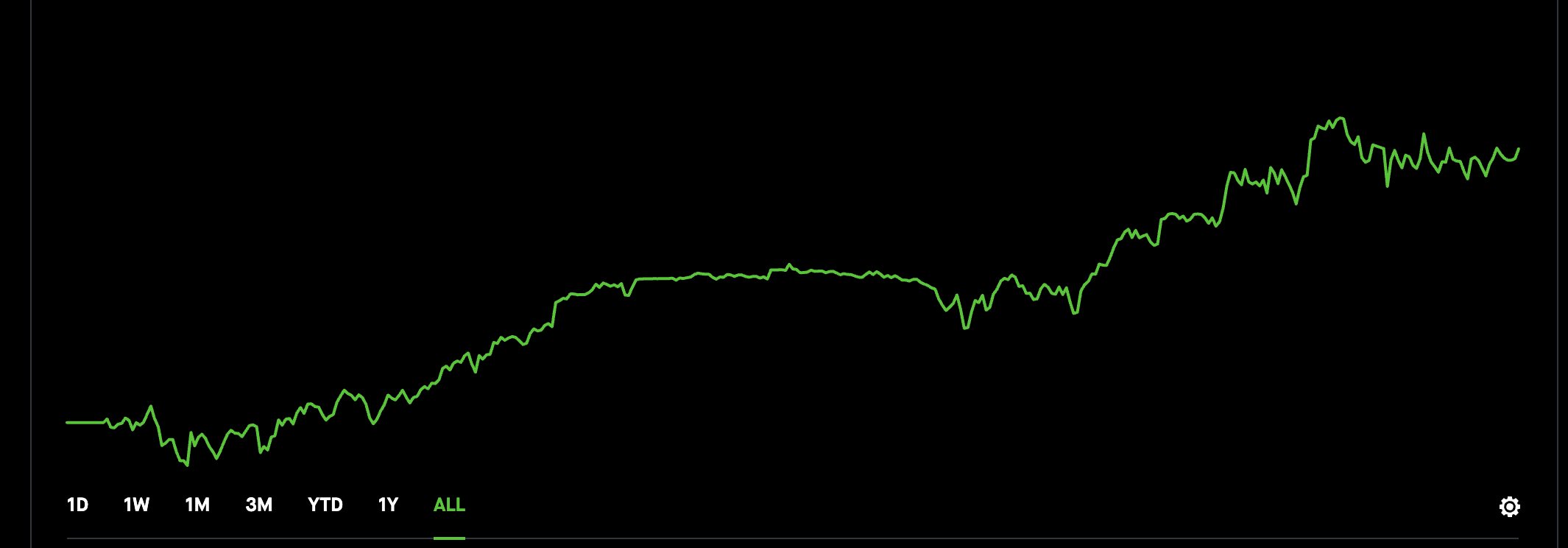
The chart hides the balance, but it shows the part that matters: a small annual bucket can become meaningful when it gets time and a strong market behind it. My account benefited from an unusually good period for stocks. That return is not a promise. The tax treatment is the durable part.
A Roth IRA takes money that has already been taxed. If you follow the qualified distribution rules, future gains come out free of federal income tax. The original owner also has no lifetime required minimum distributions.1
For 2026, the IRA contribution limit2 is $7,500 for someone under 50. That does not sound life-changing. But there is no corresponding cap on how much the investments inside the account can grow.
That is why I think Roth space is too valuable to ignore. The contribution itself is simple. The check that comes first is not: if you hold pre-tax money in a traditional, SEP, or SIMPLE IRA, the pro-rata rule can make part of the conversion taxable, and a newly opened traditional IRA does not count as separate from the old ones.
The Roth IRA income limit, and why the backdoor exists
If your income is below the direct Roth IRA threshold, the process is simple: contribute directly.
For 2026, direct Roth contributions phase out2 between $153,000 and $168,000 of modified adjusted gross income for single and head-of-household filers, and between $242,000 and $252,000 for couples filing jointly. Above the applicable range, a direct contribution is unavailable.
That creates a strange result. A high earner may be maximizing a 401(k), using a mega backdoor Roth through work, and still have money available to invest. The normal Roth IRA door is closed, even though the same person can still make a traditional IRA contribution.
The catch is that the traditional IRA contribution may not be deductible. If I am contributing after-tax money either way, I would rather move that money into a Roth than leave future gains taxable when withdrawn.
The backdoor Roth does not create a new contribution limit. It changes how a high earner reaches the same IRA limit.
How to do a backdoor Roth IRA in three steps
Despite the name, the transactions are ordinary: a nondeductible traditional IRA contribution followed by a Roth conversion.
Here is the simplified version I have used:
- Check every pre-tax IRA balance. Look across traditional, SEP, and SIMPLE IRAs, not just the account receiving the new contribution.
- Contribute to a traditional IRA without taking a deduction. For 2026, that is up to $7,500 if you are under 50 and have enough taxable compensation. A spouse may also be eligible based on the couple’s taxable compensation when filing jointly, but each spouse needs a separate IRA.
- Convert the contribution to a Roth IRA. I do this promptly so there is little or no intervening gain. Immediate conversion is practical, not an IRS requirement. Any gain before conversion can be taxable.
Then comes the step that is easy to overlook: report the nondeductible contribution and conversion on Form 8606.3 That form tracks the after-tax basis so the same dollars are not taxed twice.
If both spouses use the strategy, each files a separate Form 8606.
Forgetting during the calendar year does not necessarily mean losing that year’s IRA contribution room. Under IRS contribution-timing rules,4 a 2026 traditional IRA contribution can generally be made until the original federal tax-filing deadline in April 2027, not including extensions. Tell the IRA provider that the contribution is for 2026. Otherwise, it may be recorded as a 2027 contribution.
The Roth conversion cannot be backdated. The Form 8606 instructions5 report conversions for the calendar year in which they occur. If you make a 2026 nondeductible contribution in early 2027 and convert it in 2027, the contribution belongs on your 2026 Form 8606 while the conversion is reported for 2027. That can create paperwork across two tax returns, so make sure both years are handled correctly.
How to do the conversion on Robinhood
The tax mechanics are the same at any custodian, but the buttons differ. Robinhood’s current instructions provide one concrete example. This is an interface illustration, not an endorsement.
Robinhood currently says the conversion must start from a self-directed traditional IRA. The destination can be a self-directed or managed Roth IRA. For a backdoor Roth, the app flow is:
- Open both IRA types and fund the traditional IRA with the nondeductible contribution.
- Wait until the contribution is available as withdrawable cash.
- From the self-directed traditional IRA, go to Retirement → Settings.
- Under IRA settings → Actions, select Start a Roth conversion.
- Enter the amount, review the destination and tax year, then select Convert.
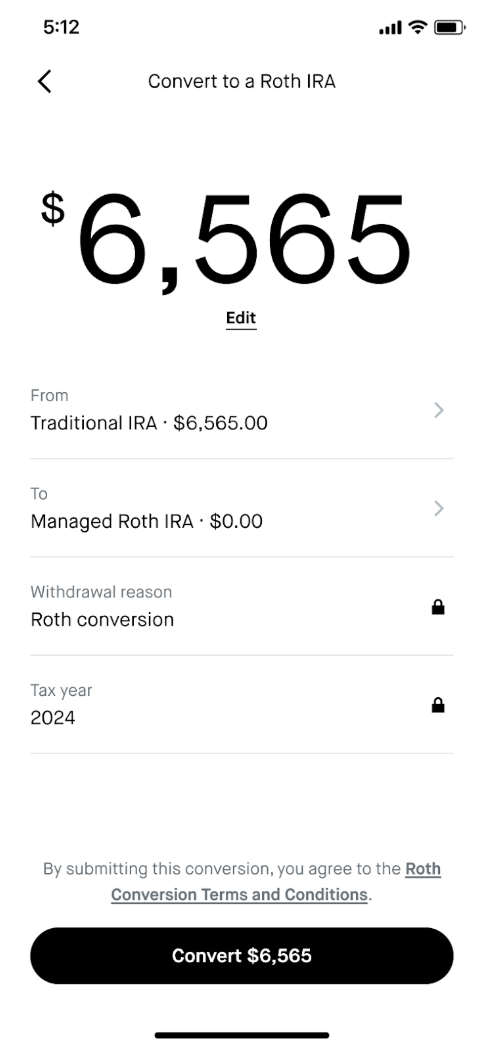
Robinhood says its current flow supports cash-only conversions and that a bank deposit can take up to five business days to become available. It also warns that conversions completed after December 31 count for the following tax year. Check the live instructions before acting because app steps can change.
The pro-rata rule: why an old IRA balance changes the math
I was fortunate not to have an old 401(k) rolled into a traditional IRA. My pre-tax IRA balance was zero, so the conversion was relatively clean.
Zero is not a formal requirement. It is a useful simplification.
Form 8606 looks across all of your traditional IRAs5 at year end. Its definition generally includes traditional SEP and SIMPLE IRAs too. You cannot place $7,500 of new after-tax money in a separate account and tell the IRS to convert only that clean slice while ignoring the rest.
Suppose you have $92,500 of pre-tax IRA money and add a $7,500 nondeductible contribution. Your after-tax basis is only 7.5% of the $100,000 total. A conversion would be mostly taxable, even if the new contribution sat in a different traditional IRA.
This is the pro-rata rule, and it is the reason someone with an existing IRA should pause before following a three-step checklist. A workplace 401(k) is not part of this IRA calculation, and some employer plans accept incoming IRA rollovers, but moving money has its own costs and rules. This is where I would involve a tax professional.
What I hold inside the Roth
I tend to use Roth space for some of my higher-growth investments. My reasoning is simple: if an investment compounds much faster than expected, the upside can remain inside a tax-free account.
I do the same inside my health savings account, the one account with a better tax deal than a Roth.
Peter Thiel is the extreme illustration. A 2021 ProPublica investigation7 reported that he turned a Roth IRA worth less than $2,000 in 1999 into about $5 billion by 2019, largely through private-company investments unavailable to ordinary investors.
That is not a repeatable investing strategy. The reporting also raised serious questions about valuation and transactions involving private shares. The useful lesson is narrower: the contribution limit caps what enters a Roth, not what a successful investment inside it can become.
There is a downside to putting aggressive investments in scarce Roth space. A large loss wastes room that cannot simply be replaced. My approach is a choice about asset location, not a recommendation to concentrate a retirement account in speculative positions.
I also use IRA accounts when rebalancing. Selling an investment inside an IRA does not create the same current capital-gains bill that selling in a taxable brokerage account can. I still decide the allocation across the whole portfolio; I just pay attention to which account should do the selling.
Three common Roth IRA misconceptions
- All Roth money is locked up for five years. Regular Roth IRA contributions do not have to remain untouched for five years. Roth ordering rules8 treat regular contributions as coming out first. Earnings have stricter qualified-distribution rules, and conversions can carry their own five-year early-withdrawal clocks. “Five years” is not one universal Roth rule.
- The backdoor and mega backdoor strategies automatically put more than $80,000 into Roth accounts. The regular under-50 limits for 2026 are $72,000 of total annual additions9 to an eligible workplace plan and a separate $7,500 IRA contribution, or $79,500. Employer contributions use part of the $72,000, and the plan must support the mega backdoor mechanics. Catch-up contributions can raise the total for older savers.
- An inherited Roth IRA receives the same basis step-up as a taxable investment. It does not. Most nonspouse designated beneficiaries8 must empty the account by the end of the tenth year after death. A spouse has additional choices, and qualified Roth withdrawals may still be income-tax-free. Estate and beneficiary rules are too dependent on the facts to treat that as a simple bonus feature.
Why I wish I had started sooner
The backdoor Roth is not exciting in any one year. It is $7,500 moved from one account to another, plus paperwork.
Its value appears later. Contributions since 2021 gave me a meaningful pool of money whose future qualified growth can be tax-free. Starting earlier would have given that pool more time.
For me, Roth space comes after the money I need to keep accessible. Retirement tax treatment is valuable, but it does not replace a cash reserve for nearer-term needs.
If you are under the direct Roth income limit, use the front door. If you are over it, have taxable compensation, and have no complicating pre-tax IRA balance, learn how the backdoor works. If you do have an IRA balance, do not pretend it is not there.
The contribution limit resets every year. The years you skip do not come back.
Sources
- 1IRS. Required minimum distributions FAQs
- 2IRS. 2026 401(k) and IRA limits
- 3IRS. About Form 8606
- 4IRS. Publication 590-A: IRA contributions
- 5IRS. Instructions for Form 8606
- 6Robinhood. Roth conversions
- 7ProPublica. Lord of the Roths
- 8IRS. Publication 590-B: IRA distributions
- 9IRS. 401(k) and profit-sharing contribution limits
All sources checked September 21, 2026.