
Pay Medical Bills in Cash. Let the HSA Compound.

Summary
- I invest my HSA, pay current medical bills from cash, and preserve the receipts for tax-free reimbursement later.
- Two years of deposits left invested have grown to about $35,000, but state taxes and other health accounts can change the result.
- Use this approach only if you can fund today’s care without the HSA and can keep durable records of every eligible expense.
A health savings account is the only account where money goes in untaxed, grows untaxed, and comes out untaxed for medical care, at least federally. California and New Jersey still tax the way in. The way to use it is to invest the balance, pay bills from cash, and reimburse yourself later.
I put money into a health savings account for exactly two years, 2023 and 2024. Then I stopped, for reasons that had nothing to do with the account. The balance is now about $35,000.
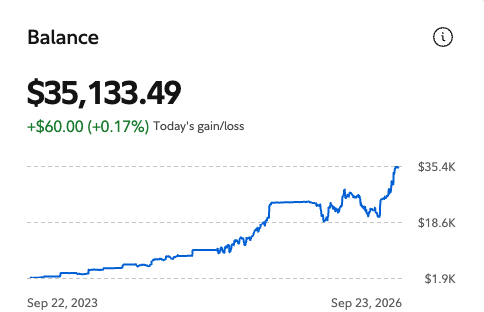
The money in was $8,000, including $2,000 from my employer. The rest is investment growth over a very good stretch for stocks. I would not plan on four times in three years. I would plan on the mechanism, because the mechanism is the durable part.
Most people treat it as a debit card for copays. That is the least valuable way to use it.
What an HSA is, in one paragraph
A health savings account is a personal account you can open only while you are covered by a high-deductible health plan, usually through work. For 2026 the IRS defines that as a plan with a deductible of at least $1,700 for one person or $3,400 for a family, and an out-of-pocket cap of no more than $8,500 or $17,000. You can contribute up to $4,400 for self-only coverage or $8,750 for family coverage1 in 2026, and any employer money counts toward that cap. Contributions through payroll skip federal income tax and Social Security and Medicare tax. The balance can be invested. Withdrawals for qualified medical expenses are never taxed federally. Unlike a flexible spending account, the money is yours, it rolls over forever, and it follows you when you change jobs.
That is the triple tax advantage everyone quotes. The part they skip is the timing.
Here is what my two years looked like against the limit at the time, and what the limit has become since.
| Year | Self-only limit | What went into mine |
|---|---|---|
| 2023 | $3,850 | The full limit: $2,850 from me, $1,000 from my employer |
| 2024 | $4,150 | The full limit: $3,150 from me, $1,000 from my employer |
| 2025 | $4,300 | Nothing. We switched to a traditional plan. |
| 2026 | $4,400 | Nothing. The balance kept compounding. |
HSA reimbursement has no time limit, so pay now
Here is the rule from IRS Publication 969:2 you can take a tax-free distribution to reimburse any qualified medical expense you incurred after the account was established. There is no deadline. IRS guidance from 2004 spells out3 that an expense from one year can be reimbursed in a later year, as long as it was not already reimbursed or deducted.
So we do not touch the account. Copays, deductibles, prescriptions: we pay them ourselves and file the receipt. Every one of those receipts is a withdrawal we can take in 2040 if we want to, tax-free, for the amount on the receipt. Meanwhile the $35,000 keeps compounding.
The receipts are the withdrawal right. The balance is the investment. Keeping them separate is the whole strategy.
The routine is four steps, and none of them involve the HSA provider.
- Pay the bill from cash. We use a card that gives 3 percent back, then pay the card in full. The HSA never sees the transaction.
- Save the receipt as a PDF the same day. One folder, one file per bill, somewhere that survives a phone upgrade. Name it so you can still identify it in 2040, and keep the insurer’s explanation of benefits when the receipt is vague.
- Know the total. Add each receipt to a running list so you always know how much you could withdraw tax-free.
- Reimburse whenever it suits you. Next year, in a lean year, or in retirement. The rule sets no deadline.
One rule to respect: the expense has to be dated after you opened the HSA. So open the account the first year you are eligible, even if you deposit very little.
What counts as a qualified expense
- Yes: doctor, hospital, and therapy bills, dental and vision care including glasses, prescriptions, over-the-counter medicines, and menstrual products. The full list is IRS Publication 502.4
- Premiums, only these: long-term care insurance, COBRA, health coverage while you collect unemployment, and Medicare premiums once you are 65, but not Medigap.
- No: ordinary health insurance premiums, gym memberships, and anything bought for general health rather than to treat a condition.
Why I stopped contributing, and why that was fine
I did not stop because the account disappointed me. I stopped because the plan attached to it did.
There was a facility we wanted to use, and it sat on a different carrier’s network. Then we got married, and the health plan decision became a household decision. Two people, two sets of doctors, two sets of expected bills. A traditional plan with lower deductibles and a health FSA fit the two of us better than a high-deductible plan fit me alone. So we switched.
That is the right way round. The insurance is the decision. The HSA is a bonus that comes with one of the choices. If the high-deductible plan does not fit your medical life, the tax benefit does not rescue it.
What surprised me is what happened to the account afterward: nothing bad. You cannot add to an HSA while you are not on a high-deductible plan, but the balance stays, stays invested, and stays available for qualified expenses. Two years of contributions were enough to create an asset that is still working years later. That is the point I most want to land. You do not need a decade of deposits. You need one deposit and the discipline to invest it.
The married-couple trap
We learned this one after the wedding, which is the expensive time to learn it.
If either spouse is enrolled in a general-purpose health FSA, neither spouse can contribute to an HSA that year. The reason is that a health FSA can reimburse the other spouse’s expenses, so it counts as disqualifying coverage for both of you. The IRS spelled this out in Revenue Ruling 2004-45.5
Combinations that work for a couple
- Both on high-deductible plans. One or two HSAs, and no general-purpose health FSA for either of you.
- Both on traditional plans. A health FSA is fine here, because neither of you is contributing to an HSA.
- One of each. The high-deductible spouse contributes to the HSA. The other spouse skips the health FSA, or uses only a limited-purpose FSA for dental and vision.
If you already signed up for one HSA and one general-purpose FSA, the HSA contributions are excess contributions and need to be corrected. Check this at open enrollment, before the plan year starts, with both benefits portals open at the same time.
One more spousal detail that cuts the other way: an HSA can pay qualified expenses for the owner, the spouse, and dependents, whether or not those people are covered by the high-deductible plan. My HSA can cover my wife’s copay even though she is on a different plan.
HSA vs. FSA: who should pick the high-deductible plan
Compare a high-deductible plan with a traditional plan
The usual advice is that young, healthy people should take the high-deductible plan and invest the HSA. I agree with the usual advice, with the reasoning spelled out.
When you rarely see a doctor, the lower premium and the tax-free contribution are pure gain, and the deductible is a number you may never reach. If you do get hit, the out-of-pocket cap limits the damage: $8,500 for one person in 2026, $17,000 for a family. You can look at that worst case, compare it with the premium difference plus the HSA contribution, and decide whether you can carry it. An emergency fund makes that answer easier. Ours covered a $10,000 vet bill without touching investments, and the same reserve is what lets me leave the HSA alone.
The traditional plan wins when the bills are recurring: a chronic condition, regular prescriptions, an ongoing treatment, a pregnancy you are planning for. Predictable spending makes the lower deductible worth its premium, and a health FSA gives you a smaller pre-tax bucket for it, $3,400 in 2026.6 The catch is that the FSA mostly expires at year end, with at most $680 carrying over. It is a spending account. The HSA is a savings account.
| Question | High-deductible plan with HSA | Traditional plan with FSA |
|---|---|---|
| Premiums | Lower | Higher |
| First dollars of care | You pay, up to the deductible | Copays from the first visit |
| Worst case, 2026 | $8,500 self-only, $17,000 family | Set by the plan, usually lower |
| Pre-tax account | HSA, up to $4,400 or $8,750 | Health FSA, up to $3,400 |
| Unused money | Stays yours, can be invested | Mostly forfeited, $680 carryover at most |
| Fits best when | Care is rare and a reserve can absorb a bad year | Bills are recurring or a specific network matters |
How I invest my HSA
I treat the HSA like my IRAs. It holds index funds and a few individual companies I have high conviction in, and I leave it alone. That is the same approach I described for the backdoor Roth IRA and the mega backdoor Roth: put the highest expected growth where the growth is tax-free.
Two cautions belong beside that. First, the 4x came from an unusually good market, and a bad three years would have shown a very different number. Second, an HSA is eventually a medical cushion, so as it gets closer to being needed, the allocation should get more boring. Mine is still in the growth phase.
If your HSA is still sitting in cash, check whether the provider requires a cash floor before you can invest. Optum Bank sets it at about $2,000;7 Fidelity has no minimum.8 That floor is the usual reason a three-year-old HSA has earned nothing.
Is an HSA tax-free in California?
Show the California and New Jersey tax details
I live in California, and California does not recognize HSAs. The Franchise Tax Board’s Schedule CA instructions9 say it plainly: federal law allows a deduction for HSA contributions, and California law does not conform. In practice that means:
- My contributions and my employer’s contributions were added back to California income in the years I made them.
- Dividends and interest inside the account are taxable to California every year.
- When I sell something inside the HSA at a gain, that gain is a California adjustment too.
New Jersey does the same. Everywhere else, as far as I can tell, follows the federal treatment.
It is a real cost. The state tax on $8,000 of contributions, plus a small yearly bill on dividends, is the price I paid. The federal side still made it worth doing: no federal income tax on the way in, none on the growth, none on the way out for medical bills. If you are in one of the two states, count the benefit as double tax-free rather than triple. It is still the best account available to you.
Why I am saving it for later
Medical costs grow faster than almost everything else. The federal actuaries at CMS project national health spending10 to grow 5.4 percent a year through 2034 against 4.1 percent for the economy as a whole, taking health care from 18 percent of GDP to 20.6 percent. Fidelity’s 2026 estimate puts a 65-year-old’s lifetime retirement health costs at $185,500,11 up 7.5 percent in one year, and about $371,000 for a couple. That excludes long-term care.
Those are the bills the HSA is for. A $35,000 balance that compounds for another 25 years is a meaningful piece of that number, funded by two years of contributions I barely noticed at the time.
And if we never need it all, the account does not become a trap. After 65, withdrawals for anything are taxed as ordinary income with no penalty, the same as a traditional IRA. Before 65, a non-medical withdrawal costs income tax plus 20 percent, so treat it as untouchable until then.
What to do with this
- 01
Open it the first year you can
Even a small deposit starts the clock for receipts and gives you an account to invest.
- 02
Move it out of cash
Clear the provider’s cash floor, buy funds, and pay medical bills from your own account while the balance compounds.
- 03
Check the couple rule before enrollment
One general-purpose FSA blocks both spouses from contributing. Fix it before the plan year starts.
If you live in California or New Jersey, do the math with state tax included. It still works. It just works a little less.
Sources
- 1IRS. Revenue Procedure 2025-19 (PDF)
- 2IRS. Publication 969: Health savings accounts
- 3IRS. Notice 2004-50 (PDF)
- 4IRS. Publication 502: Medical and dental expenses
- 5IRS. Revenue Ruling 2004-45 (PDF)
- 6Newfront. 2026 health FSA limit
- 7Optum Bank. Options to invest your HSA funds
- 8Fidelity. Health Savings Account
- 9California FTB. 2025 Schedule CA (540) instructions
- 10CMS. National health expenditure fact sheet
- 11Fidelity (Business Wire). 25th annual retiree health care cost estimate
All sources checked September 24, 2026.