
Credit Card Rewards Math: One Card or Several?
Summary
- One strong flat-rate card captures most of the credit card rewards available from normal spending.
- In my example, a category-card stack earns about $470 more than one 3% card on $72,000 of annual spending, before fees.
- Add another card only when its extra reward exceeds its fee, complexity, and risk of encouraging more spending.
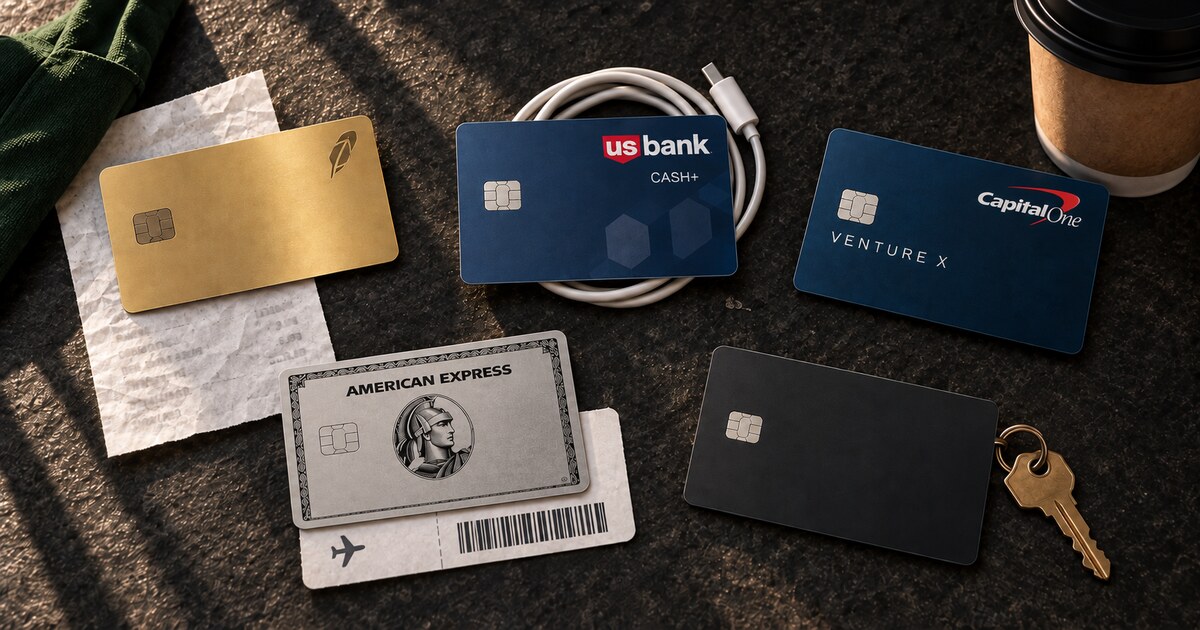
I have several credit cards, and each one is there for a reason I can show with arithmetic. That is not a reason for you to have several. It is not even the main reason to have one.
Credit cards are, first, a very good way to pay. They work everywhere. With Apple Pay or Google Pay the cards can stay at home. And they protect you in ways a debit card does not. Rewards come third. They are also the reason most people get a card, so they deserve the clearest thinking, and they usually get the least.
One strong flat-rate card captures most of the reward on spending you would do anyway. Add a category card only when the extra return is worth its fee and the effort of remembering it, and put the right card on the right bill. Annual fees, credits, lounges, and insurance are separate calculations.
How many credit cards do you need? Start with one
Get one card that pays the highest rate on everyday purchases, with no categories to track. Put everything on it. Pay it in full every month.
For me that card is the Robinhood Gold Card, which pays 3% on every purchase.1 It needs a Robinhood Gold subscription, about $50 a year, and the rewards land as points worth a cent each in a Robinhood account. That one card gets me about 80% of what my whole stack earns in a year.
Everything else in this essay is the work of chasing the last 20%. I do it because it adds a few hundred dollars for me. It does not have to be you.
Many cards pay a flat 2% with no categories to track, including fee-free ones such as the Citi Double Cash2 and premium ones such as the Capital One Venture X.3 Any of them, paid in full every month, is a complete strategy. Most people never get that far. The 3% card is simply the best flat rate I have found.
If you are considering a card with a large annual fee, I have also compared the Amex Platinum with the Chase Sapphire Reserve using only benefits that replace our actual spending.
The one rule
The statement is paid in full every month, without exception. Everything below rests on that one condition.
Interest on a credit card runs at roughly ten times the best cash-back rate. One month of interest wipes out a year of rewards. If paying in full is not already your habit, the rest of this essay does not apply yet. Build the habit first. Once it is, paying early instead of on the due date costs only a little interest.
What a card actually gives you
- 01
Convenience
One tap, anywhere in the world, and your phone carries every card you own.
- 02
Protection
If someone steals your number, the most you can lose is $50 by law,4 and banks usually waive that. A debit card is riskier: report within two days and you lose $50 at most, wait longer and you can lose $500, wait past 60 days and the money can be gone. When you dispute a charge on a credit card, the bank’s money is on hold while it investigates.5 On a debit card, your money is.
- 03
Rewards
Cash back returns a percentage of each purchase. Points are the same thing with an extra step: they turn into travel, or transfer to airlines and hotels where each point can be worth more than a cent. Rewards are the smallest of the three benefits, which is why they should be decided last.
A bonus on a big bill you were paying anyway
Most cards pay a welcome bonus if you spend a set amount in the first few months. The offers change constantly and differ by person,6 so check what a card offers today rather than trusting any number in an essay, including this one.
A bonus is only worth having on spending that was going to happen anyway. When my wedding reception came due, I opened the Platinum for it. The offer at the time was 150,000 points, roughly $1,500 of flights. I met the spending requirement in one payment, and the points paid for flights months later. That is a discount on the biggest bill of the year, earned by choosing which card to hand over.
The CFPB found7 that about one in four people who open a bonus card never meet the spending requirement. Time the card to the expense. Never the expense to the card.
Where does your money go?
A reward rate is a percentage, so what it is worth depends on what it multiplies. The useful question is not which card is best. It is where your money already goes.
I know exactly where mine goes because I have tracked every expense for ten years. For most households the big categories are housing, food, travel, shopping, and utilities. Rent and mortgages rarely take a card without a fee, so the game is played on the rest.
The method is short. Find your two or three biggest categories that take a card. Put the highest-rate card you can justify on each. Put a flat-rate card on everything else. A 6% rate where you spend $500 a month is worth more than a 5% rate where you spend $50. And a flat 3% on everything is the floor any specialist card has to beat.
My stack
Rates below are as published by each issuer on September 18, 2026. They change, and issuers add caps. Check the current terms before you apply.
One disclosure before the table. Two of the cards below have my referral links: the Blue Cash Preferred and the Venture X. If you are approved through one, the issuer pays me a bonus at no cost to you, and you get whatever welcome offer it shows you. For the Blue Cash Preferred that is currently as high as $300 back after $3,000 of spending in the first six months; offers vary by person. Nothing in the math below changes either way, and every rate is linked to the issuer’s own page, not a referral.
| Card | What goes on it | The catch |
|---|---|---|
| Amex Blue Cash Preferred | Groceries and streaming at 6%.8 Gas, parking, and transit at 3%. | The 6% covers the first $6,000 of groceries a year, then 1%. |
| US Bank Cash+ | Utilities, phone, and internet at 5%.9 For the holiday quarter I switch one pick to department stores or electronics. | The 5% covers the first $2,000 a quarter across both picks, and you must re-enroll every quarter. |
| Amex Platinum | Flights booked directly with the airline, at 5 points per dollar.6 | Up to $500,000 a year. The card costs $895 a year and gets its own essay. |
| Robinhood Gold Card | Everything else at 3%. | Needs the Gold subscription, $50 a year. |
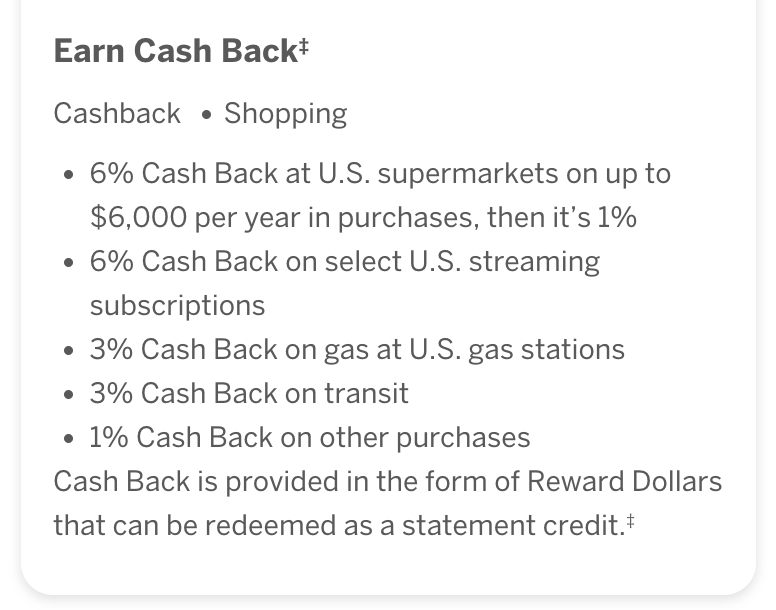
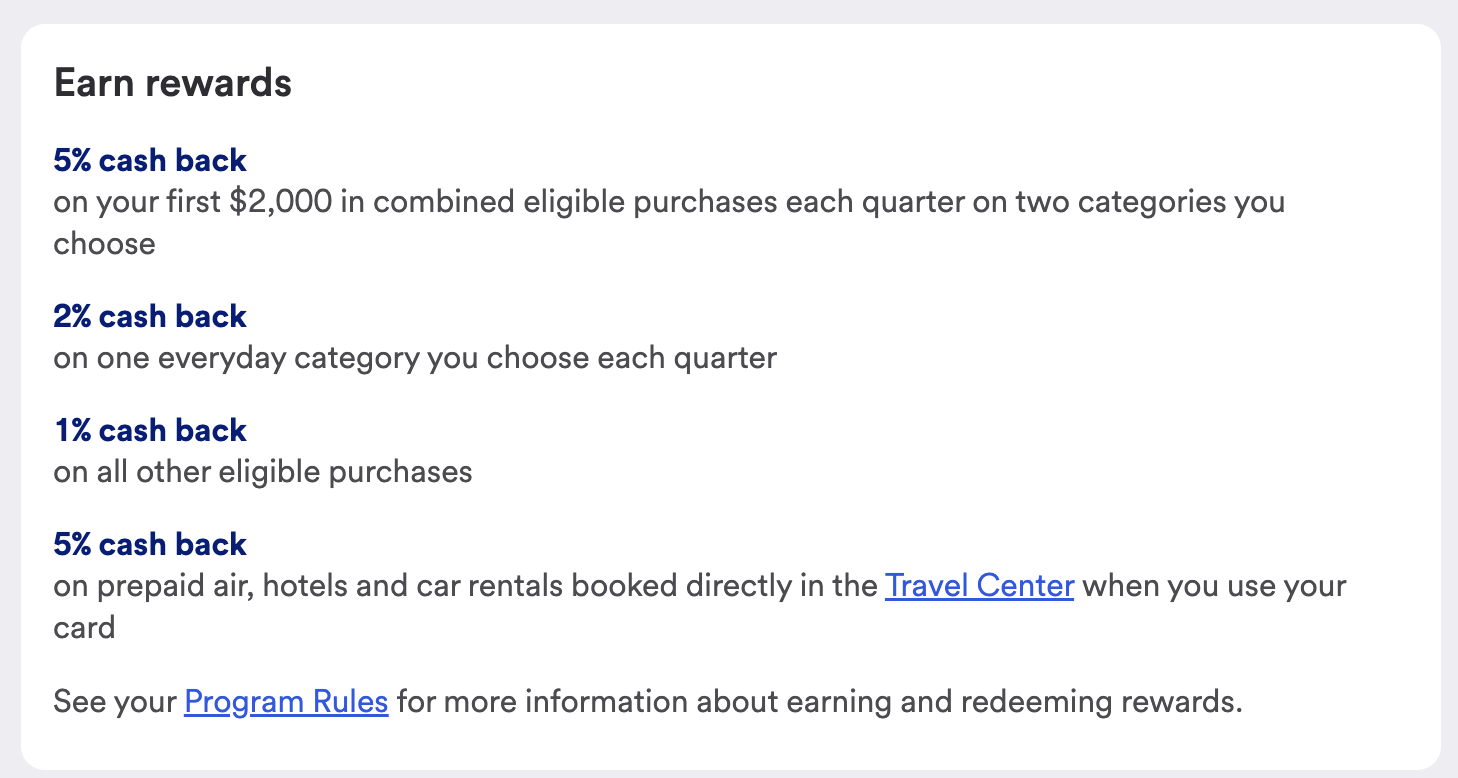
Two rows need a word more.
Cash+ is the card people set up wrong. Its 5% applies only to the two categories you pick, and only if you re-enroll each quarter. Miss the enrollment and it pays 1% on everything. My standing picks are utilities and phone. For the holiday quarter I switch one to department stores or electronics, then switch back in January.
Flights I book directly with the airline, never through a card’s travel portal. When a flight is cancelled, the airline helps its own customers first and sends portal bookings back to the portal. I have watched this happen. The Platinum pays its highest rate on exactly those direct bookings, and since I hold the card, that is where flights go. It is not the only card that rewards direct bookings; Chase’s Sapphire Reserve pays 4x and Citi’s Strata Premier 3x. The Platinum gets its own essay, because at $895 a year its earn rate is the least interesting thing about it.

Adding it up
Say you put $6,000 a month on cards, $72,000 a year.
One 3% card on everything returns $2,160.
My first guess for the stack was near $300 a month, assuming half the spending could go through 5% and 6% cards. It can’t, because of the caps. The 6% grocery rate stops at $6,000 a year. The 5% Cash+ rate stops at $8,000 a year. Together they cover $14,000 of the $72,000, not $36,000. Here is the honest version:
| Spending | Rate | Reward |
|---|---|---|
| Groceries, $6,000 | 6% | $360 |
| Utilities and holiday shopping, $8,000 | 5% | $400 |
| Streaming, $1,000 | 6% | $60 |
| Parking and transit, $500 | 3% | $15 |
| Flights, $5,000 | 5 points per dollar, a cent each | $250 |
| Everything else, $51,500 | 3% | $1,545 |
| Total on $72,000 | 3.65% | $2,630 |
That $470 is the entire prize for routing spending across several cards instead of one. Real money, not life-changing money. If that sounds like a chore you would not keep up, take the one card and the $2,160. You lose nothing that matters.
One more calculation, for people who pay estimated taxes with a credit card. The IRS takes cards through processors that charge 1.75% or 1.85%.10 A card that returns 2% in travel points, such as the Capital One Venture X, comes out 0.25% ahead: $25 on a $10,000 payment. That only becomes interesting if you reliably get more than a cent per point by transferring to airlines. Call it a hobby with a small payoff, not a strategy.
What the percentages leave out
Every number above ignores what the cards cost and what else they do. Both belong in a real decision, and this essay makes neither.
- Amex Blue Cash Preferred: $0 the first year, then $95.11 On the full $6,000 of groceries it still clears $265 after the fee. Below about $1,600 a year of groceries, the fee-free Blue Cash Everyday at 3% wins.
- US Bank Cash+: no annual fee.
- Robinhood Gold Card: no annual fee, but it needs Robinhood Gold at $50 a year.12 I pay for Gold for other reasons, so the card costs me nothing extra. If you would subscribe only for the card, count the $50.
- Capital One Venture X: $395 a year,3 offset by travel credits that need their own accounting. I keep mine for one job: paying my quarterly taxes. Referral link, disclosed above.
- Amex Platinum: $895 a year.13 On earn rate alone it loses badly. Nobody holds it for the earn rate.
The fee cards come with statement credits, lounge access, purchase protection, travel insurance, and other benefits that have to be weighed against their fees before any of them makes sense. That is a separate exercise. The rule in this essay is narrower and stands on its own: on purchases you would make anyway, the percentage back decides which card to use.
Four good reasons not to bother
- You don’t pay in full every month. Then no reward rate matters. Fix that first.
- You’d be paying fees you can’t justify. A $95 fee against $200 of grocery rewards is fine. An $895 fee against benefits you never use is not.
- Tracking which card to use is a burden. Use one card at 3% and keep the $2,160. The extra $470 is not worth resenting your wallet.
- The rewards change how you spend. The CFPB reports14 that rewards are the top reason people give for spending more on their cards. At 3.65% back, an extra $100 spent to earn a reward costs you $96.35. The cards only work on money that was leaving anyway, the same test I apply to food delivery discounts.
Pull three months of spending, find your two biggest categories that take a card, and check whether any card pays 5% or 6% there. If one does, that is your second card. If none does, a flat-rate card and a paid-in-full habit is the whole plan.
Card terms above are as published on September 18, 2026 and change often. This essay describes how I use my own cards and is not individualized financial advice.
Sources
- 1Robinhood. Gold Card
- 2Citi. Double Cash Card
- 3Capital One. Venture X card page
- 4FTC. Lost or stolen credit, ATM, and debit cards
- 5CFPB. How do I dispute a charge on my credit card bill?
- 6American Express. Platinum Card
- 7CFPB. Credit card rewards issue spotlight, May 2024 (PDF)
- 8American Express. Blue Cash Preferred Card
- 9U.S. Bank. Cash+ Visa Signature Card
- 10IRS. Pay your taxes by debit or credit card
- 11American Express. Blue Cash Preferred vs. Blue Cash Everyday
- 12Robinhood. How do I pay for Robinhood Gold?
- 13American Express. Platinum Card annual fee
- 14CFPB. Circular 2024-07 on credit card rewards programs
All sources checked September 18, 2026.