
Paying Quarterly Taxes With a Credit Card: Is It Worth It?
Summary
- Paying the IRS by card costs a 1.75% fee. It pays off only when the rewards plus the interest on the cash beat that fee.
- On $10,000, the Venture X’s 2x miles beat the fee by $28.50, and about 50 days of interest on the cash adds more.
- Pay the card in full, value miles at a redemption you will use, and count only the interest days you actually gain.
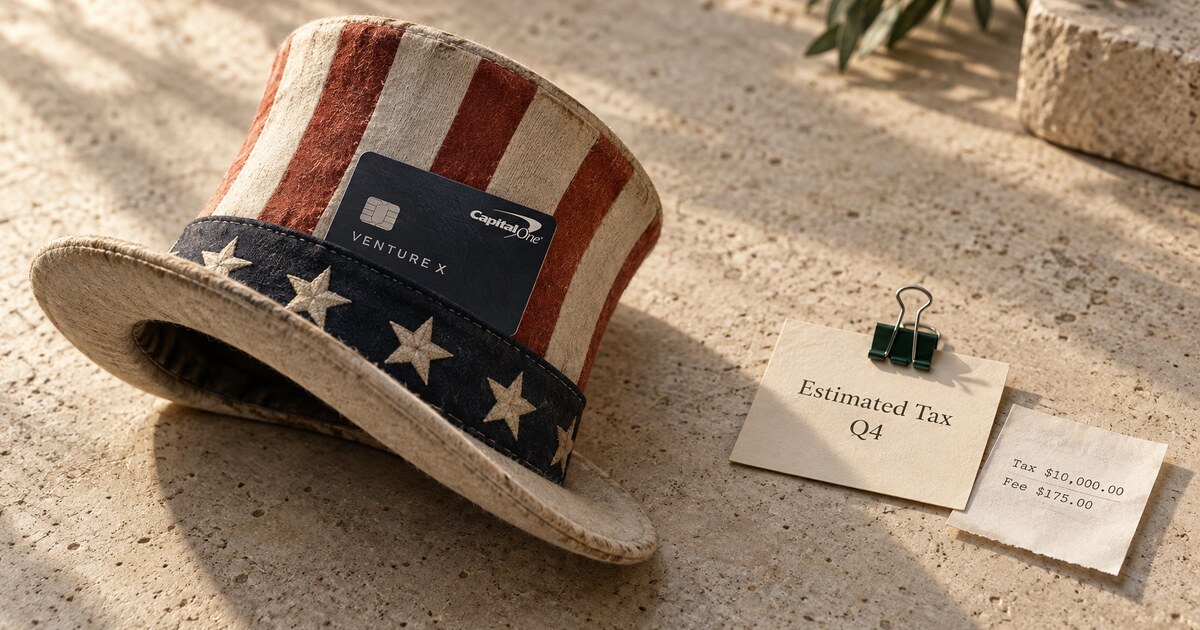
Every quarter, I pay the IRS with a credit card and a 1.75% fee. I still come out ahead.
The card is the Capital One Venture X. It used to be my default card, until the Robinhood Gold Card started paying me 3% on almost everything. Now the Venture X has one job: my estimated taxes.
It earns 2 miles per dollar on the payment, a little more than the fee costs. And because the IRS gets paid today while the card bill isn’t due for about 55 days, the cash keeps earning interest in the meantime.
Short answer: yes, if your card earns rewards on tax payments and you pay it in full. At 2x, the Venture X’s miles alone cover the 1.75% fee, and about 50 days of interest on the cash adds more.
Not life-changing. But it is money on a bill I had to pay anyway. Here is the math, and the ways it goes wrong.
What it costs to pay taxes with a credit card
Paying from your bank account through IRS Direct Pay1 is free. That is the bar a card has to clear.
For a card, the IRS sends you to one of two processors.2 Pay1040 charges 1.75% on a personal credit card. ACI Payments charges 1.85%. The fee goes to the processor, not the IRS.
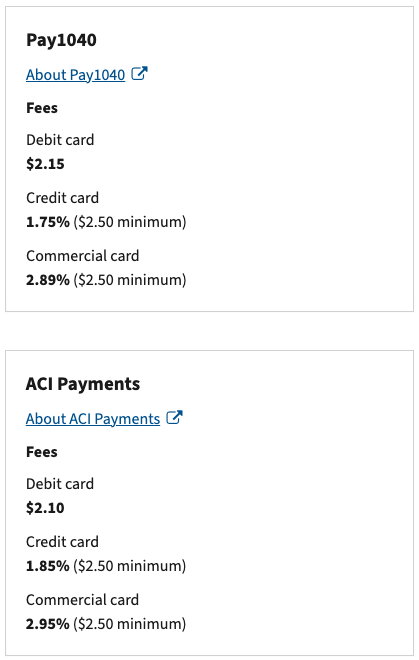
Say you owe $10,000 for the quarter and pay through Pay1040. An example, not my actual tax bill:
| A $10,000 tax payment | Amount |
|---|---|
| Tax paid to the IRS | $10,000.00 |
| Fee at 1.75% | $175.00 |
| Charged to the card | $10,175.00 |
The Venture X earns 2x on the whole $10,175, fee included: 20,350 miles, or $203.50 at a cent each. So you earn a little more than you pay: $28.50. On its own, that is barely worth the clicks. The second half of the trick is timing, but first, the card.
Which cards earn rewards on tax payments
This only works if your card earns its full rate on the payment. Mine is a good example of why you have to check.
My Robinhood card pays 3% on nearly everything I buy. Its terms exclude tax payments,3 even through a processor. Put the IRS on it and I pay $175 for nothing. Premium cards like the Amex Platinum and Chase Sapphire Reserve earn 1 point per dollar4 on taxes, about $102 back against the same $175.
The Venture X earns 2x on ordinary purchases,5 and tax payments count. It also has a much higher credit limit than my Robinhood card, which matters when one charge is the size of a quarterly tax bill.
| Card, on $10,000 of tax | Rewards at 1¢ | After the fee |
|---|---|---|
| Venture X (2x) | $203.50 | +$28.50 |
| Amex Platinum or Sapphire Reserve (1x) | $101.75 | −$73.25 |
| Robinhood Gold (nothing on taxes) | $0 | −$175.00 |
So Robinhood gets my everyday spending. The Venture X gets the IRS.
Any card that earns a full 2% on the payment gets you the same $28.50. Check your card’s exclusions before you try it.
Charge it after the statement closes, pay by the due date
The IRS is paid the day you charge the card. You don’t pay the card until its due date. If the charge posts just after your statement closes, it lands on the next statement, a full billing cycle away. The Venture X terms6 then give at least 25 more days, the grace period, to pay. That is about 55 days from the charge to the due date.
If the cash sits in SGOV, you need to sell it a few days before the card is due: the sale takes a business day to settle, and the move to your bank another day or two. So I count about 50 days of interest, not 55.
- Day 0Statement closes
- Day 1Charge the tax
- About day 30Next statement closes
- About day 50Sell SGOV, move the cash
- About day 55Card payment due
Until then, the $10,000 keeps earning. Say it sits in SGOV, the Treasury bill fund where I keep most of my emergency fund. From Treasury bill yields on October 9, 2026, less its fee, I estimate SGOV earns about 4.01% a year before tax. For 50 days, the interest works out to:
$10,000cash×4.01%yield×50 ÷ 365days=$54.93interest
Now the same payment looks like this. The first two columns are my usual and best redemptions; the third is The Points Guy’s valuation7 of Capital One miles, the high end:
| Value per mile | 1¢ | 1.25¢ | 1.85¢ (TPG) |
|---|---|---|---|
| Miles | $203.50 | $254.38 | $376.48 |
| Interest, 50 days | $54.93 | $54.93 | $54.93 |
| Fee | −$175 | −$175 | −$175 |
| Net benefit | $83.43 | $134.31 | $256.41 |
Before tax on the interest. SGOV estimate from Treasury bill yields on October 9, 2026, less its fee. iShares reports a 30-day SEC yield of 3.72%; it looks backward and lags when rates move.
Count only the days you gain
If you would have paid the IRS on the 15th, charging the card on the 1st to catch the statement does not give you 14 extra days. You would have earned interest on that cash anyway.
The IRS deadline does not move either. Charge early in the cycle only when that still lands before the due date.
I usually pay my credit card bills early, because a clean balance keeps my monthly budget easy to read. Taxes are the exception. The payment is usually large, it has one purpose, and it is independent of my monthly budget. I could pay from my bank account. I use the card for this one purpose, so I let the charge wait until its due date.
Not sure SGOV beats your savings account? The calculator compares them after tax, in your state:
What my Capital One miles are worth
All of this assumes the miles are worth at least a cent.
I use mine for flights and hotels when I travel. Most of the time that is a cent a mile. Capital One lets you cover travel purchases6 charged to the card in the last 90 days at that rate, so a $200 flight takes 20,000 miles. Some of my redemptions have reached 1.25 cents, and award seats can cost fewer miles than their cash price suggests.
Moving miles to airline and hotel partners8 can do better. A one-for-one transfer only tells you how many airline miles you get, not what they are worth. Price the award against a trip you would actually buy.
The Points Guy’s 1.85 cents in the table above (October 2026) is a good benchmark for what the miles can be worth. I don’t get that much, so I plan on my own 1 to 1.25 cents. Use the value you actually get.
If you won’t use these miles, this isn’t for you. Pay from your bank account, or use a cash-back card that earns its full 2% on tax payments.
Is the Venture X annual fee worth it?
For me, yes. But the $395 fee needs its own math, separate from the tax payment.
Each year the card gives a $300 credit for bookings through Capital One Travel9 and 10,000 anniversary miles, worth $100 at a cent each. From the first card anniversary, that is $400 against $395, if you would book that travel anyway. The credit only works inside Capital One Travel, not on a flight you book with the airline.
The Capital One lounges are the perk I like most, and taxes help there too.
Taxes count toward lounge guests
Spend $75,000 on the card in a calendar year10 and you get two free guests per Capital One Lounge visit and one per Landing visit, for the rest of that year and all of the next. Priority Pass guests are not included.
Tax payments are ordinary purchases on the card, so four quarterly payments can cover a good part of that $75,000. A small perk, but why not?
A tax payment can also help meet a new card’s welcome-bonus spending requirement, if you are opening one anyway.
I compared the Amex Platinum and Sapphire Reserve the same way: count only the credits that replace spending you would do anyway.
When paying taxes by credit card isn’t worth it
The rule
Only charge what you already have in cash. If you carry a balance, you may have lost the grace period,11 and one month of card interest on $10,175 can wipe out the whole benefit.
Skip it, too, if the rewards plus the interest you actually gain don’t beat the fee, or if the miles would sit unused.
Otherwise, before your next quarterly payment:
- Check your card. Make sure it earns rewards on tax payments.
- Do the math honestly. Value the rewards at a redemption you will really make, add only the interest days you gain, then subtract the fee.
- Time the charge. Just after your statement closes, as long as that is still before the IRS deadline.
- Set the cash aside. Keep the full amount ready and set autopay for the statement balance.
- Split it if you need to. The IRS allows12 two card payments per quarter for estimated tax.
That is the whole system. The Venture X lost my everyday spending to Robinhood. It kept the one bill Robinhood won’t pay me for.
Do you pay your estimated taxes by card, or straight from the bank?
Sources
- 1IRS. Direct Pay with bank account
- 2IRS. Pay your taxes by debit or credit card
- 3Robinhood. Gold Card rewards terms
- 4Upgraded Points. Paying taxes with a credit card
- 5Capital One. Venture X card page
- 6Capital One. Venture X rewards and account terms (PDF)
- 7The Points Guy. Monthly points and miles valuations
- 8Capital One. Ways to redeem Venture miles
- 9Capital One. All about Venture X
- 10Capital One. Airport lounge terms
- 11CFPB. What is a grace period for a credit card?
- 12IRS. Frequency limits by type of tax payment
All sources checked October 8, 2026.