
Covered Calls: When to Sell Them on Shares You Own

Summary
- A covered call pays you for agreeing to sell shares at a price you choose. It cushions a small decline and gives up part of a big rally.
- The premium cushions a small decline, while the call caps a large gain during its life.
- Choose the strike by asking whether you would be pleased to sell the shares at that price.
Say you bought 100 NVIDIA shares for $200 each and they now trade at $228. You are up $2,800 on paper, you still believe in the company, and you think the shares may pause for a month. You would be comfortable selling them at $235 during that time.
Someone will pay you about $500 today for the right to buy your 100 shares at $235 before a date you choose. That is a covered call: one $235 call sold for, say, $5 a share. If the buyer uses the right, you must sell. If the stock never gets there, you keep the $500 and the shares.
Some investors love covered calls because they bring in cash on stocks they already own. Others hate them because they cap the gains on those stocks. Both have a point. After eight years of trading options, I think the useful question is when you would want to make that exchange.
The prices in this example are hypothetical, not a current NVIDIA option quote. One standard equity option contract covers 100 shares. If options are new to you, the basic contract explained with onions is a useful place to start.
What happens to your shares?
If the stock finishes below $235 and the call expires unused, you keep the shares and the $500. You can then decide whether to sell another call.
If it finishes above $235, the call will likely be exercised and your shares sold at $235 each. You still keep the $500, making your effective sale price $240 a share.
Here is the whole position at expiration, before fees and taxes. Each result includes both the shares and the call, measured against your original $200 share cost.
| NVIDIA at expiration | Hold 100 shares | Shares plus $235 call |
|---|---|---|
| $190 | −$1,000 | −$500 |
| $228 | +$2,800 | +$3,300 |
| $237 | +$3,700 | +$4,000 |
| $250 | +$5,000 | +$4,000 |
At $250, the call has cost you $1,000 of the gain you would have made by simply holding the shares. You still made $4,000 from your $200 purchase price, but that forgone $1,000 matters. It is the price of taking the $500 up front.
At $190, the premium reduces your stock loss by $500. It does not make the stock safe. If NVIDIA went to zero, the shares would lose $20,000 and the call premium would offset only $500. The combined loss would be $19,500.
That is why I don’t think of a covered call as free money or reliable protection against a falling stock.
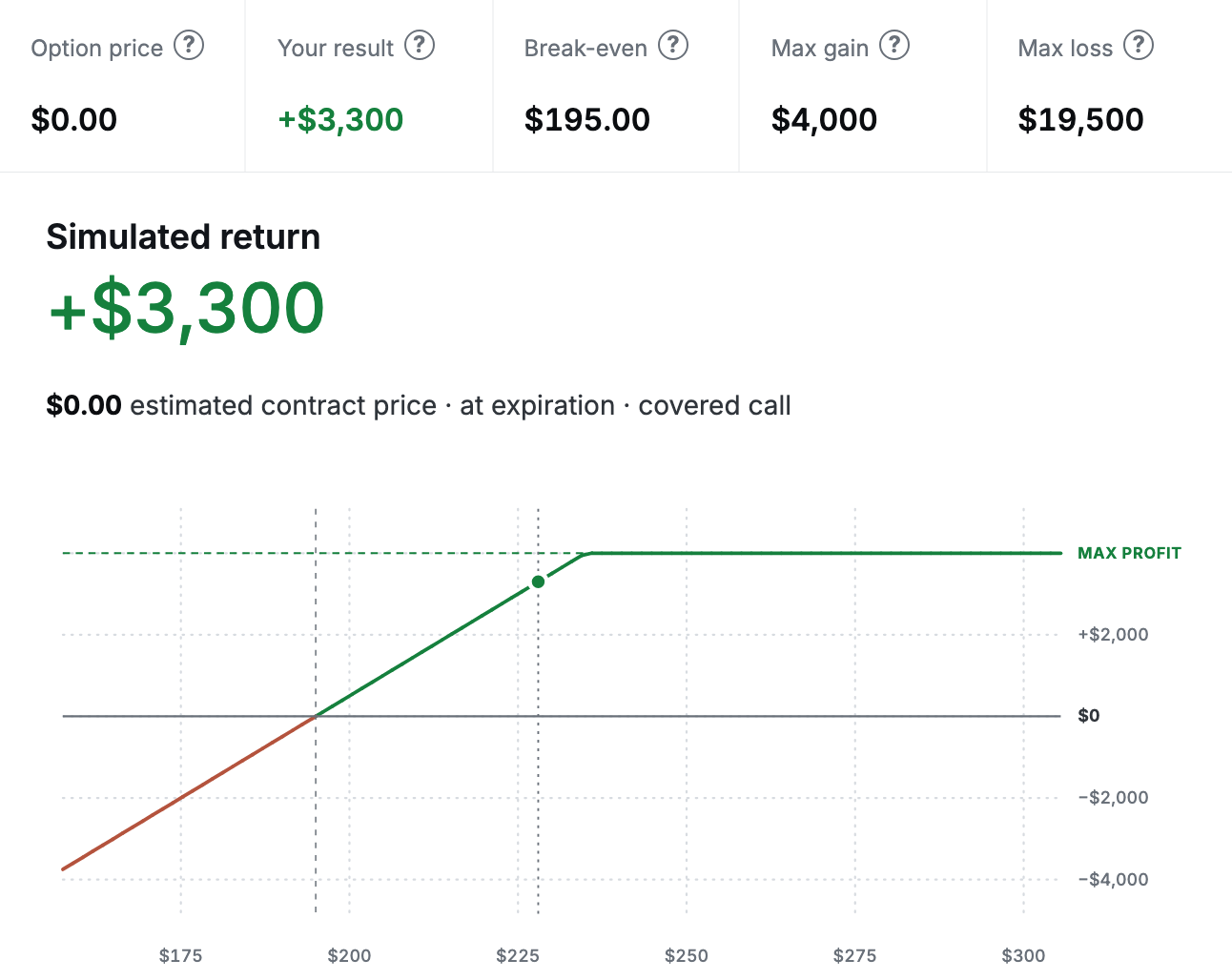
Try a different share cost, strike, or premium to see when a call helps and where it caps your gain.
Options simulatorSee the shares and call together, then change the price or time.Open the tool →
There are two prices to keep straight. $240 is your effective sale price if the shares are called away: the $235 strike plus the $5 premium. $195 is your break-even on the combined position against your original $200 share cost: the cost minus the premium.
The call buyer’s own break-even at expiration is $240. But a call that finishes above $235 may still be exercised because buying the shares at $235 is better than buying them at the higher market price.
When would I sell a covered call?
I start with my view of the stock, not with the premium on the options screen. I ask myself: if these 100 shares leave my account at the strike, will I be pleased with that sale?
If I expect a sharp rise soon, especially around an event that could change the price quickly, I may simply hold the shares. A call could leave me watching a rally that I no longer fully share in.
If I think the stock may move sideways or dip for a while, but I remain bullish over the long run, a call becomes more interesting. I can collect a premium while I wait.
If I no longer want to own the company, selling the shares is the clearer decision.
A covered call can also be an exit plan. Suppose $235 was already the price at which you wanted to sell. The call pays you for offering that price for a set period. There is still a difference from a sell order: the shares might trade above $235 briefly and come back down without being called away. You must be comfortable with either outcome.
Would I be pleased to sell these shares at this strike during this month?
This is the connection to cash-secured puts. A put pays you to wait for a price at which you would buy shares. A covered call pays you to name a price at which you would sell shares you own. In both cases, the price and the obligation matter more than the premium.
How do you choose the strike and end date?
For the strike, I choose a price where I would accept selling. A higher strike leaves more room for the stock to rise but usually pays less. A lower strike brings in more premium and makes a sale more likely. If the premium looks unusually large, I ask why the market expects the stock to move so much.
I often look about a month out. An option’s time value tends to shrink faster as expiration approaches, especially near the stock’s current price. That gives the seller a reason to consider shorter calls.
It does not make 30 days a magic number. A shorter call also gives the stock less time to stay below your strike, and you may need to make the decision again sooner.1
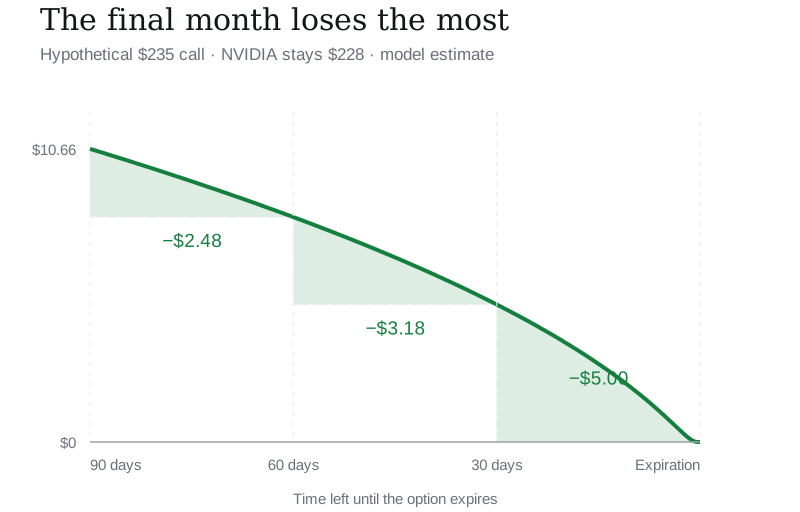
My usual starting point has been calls around 0.15 to 0.20 delta. These are often farther from the current share price, so they tend to pay less than closer strikes. I have sometimes collected roughly 1% to 2% of the share value for a month, but that is an observation from my trades, not a return you can count on. The premium changes with the stock, strike, time, and expected volatility. I would never choose a stock just because its calls pay more.
How would you sell one on Robinhood?
Robinhood requires you to own 100 shares for each covered call. With the shares in your account, choose a call’s expiration and strike in the stock’s options chain. Enter a sell order and your limit price, then review the credit and the 100 shares you may have to deliver.
Check the bid and ask: a displayed midpoint is not a promise that someone will buy your call at that price. Robinhood’s covered-call instructions2 show the current order flow. The decision about the sale price comes before the order ticket.
Here is how I read the BE screens on September 29. The first shows the share price. The second shows a call I could sell against 100 shares. These are quotes, not orders I placed.
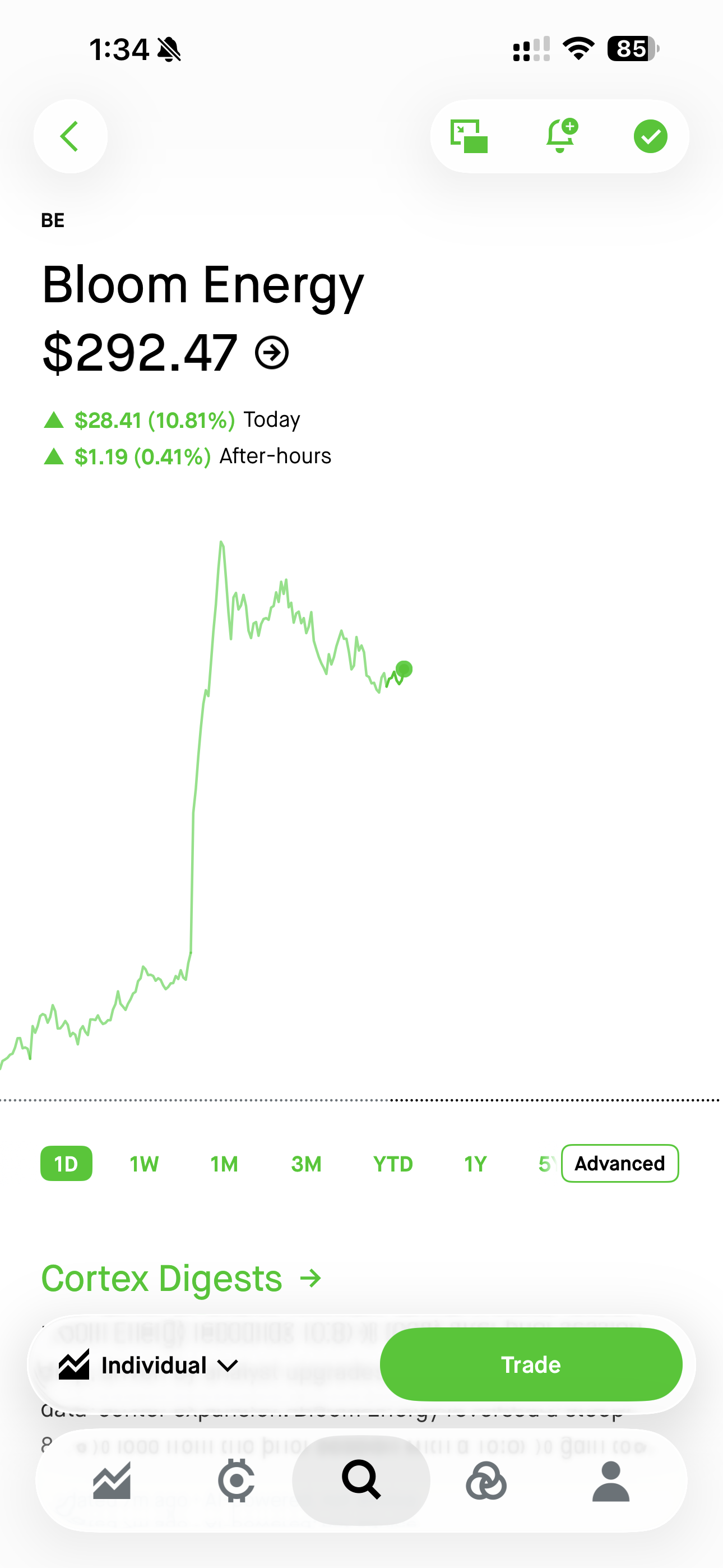
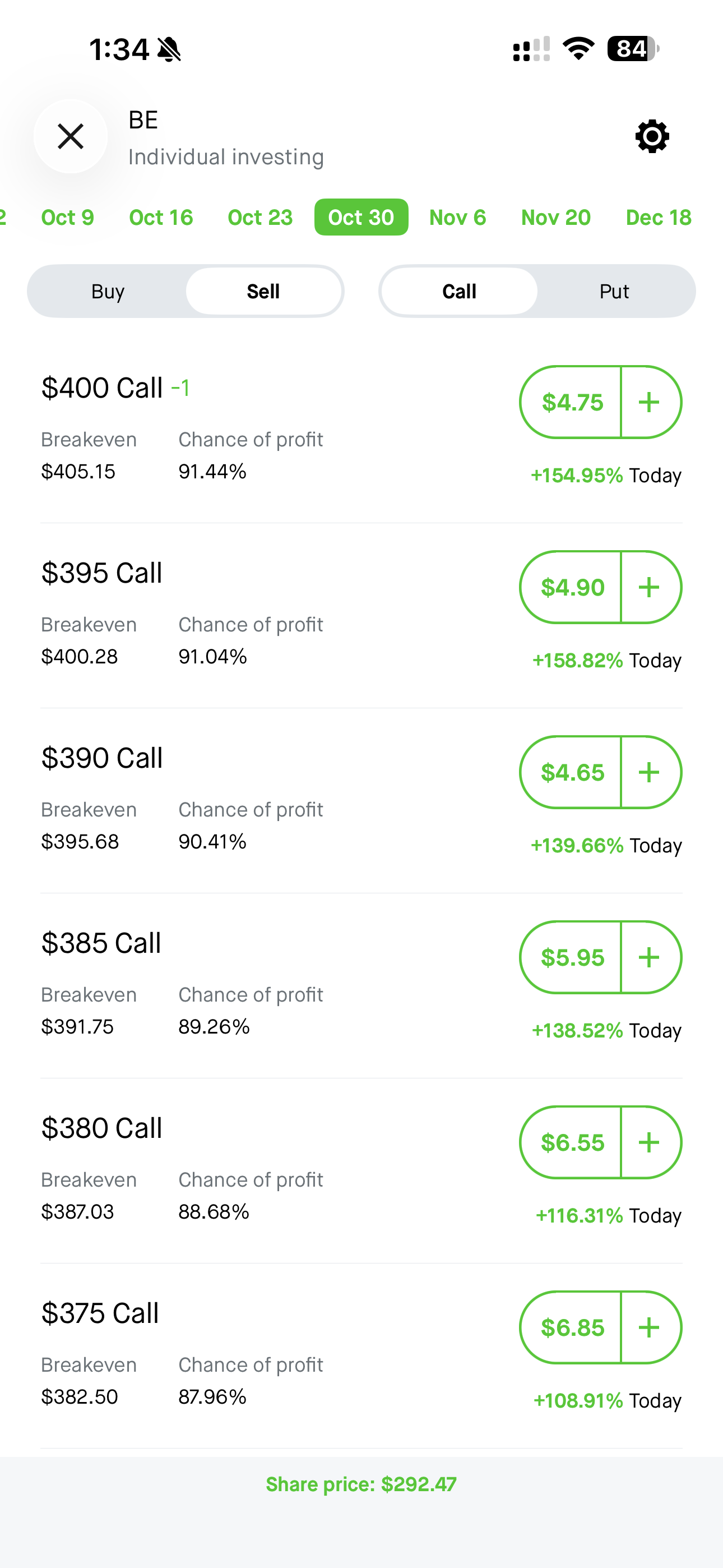
At that quote, one contract would bring in $475 before fees if it filled ($4.75 per share × 100 shares). The app also shows a $405.15 break-even, which does not equal $400 plus the visible $4.75 quote. I would use my actual filled price to work out the trade, not the screen’s estimate.
Open either image to see the full screen.
I would choose $400 only if I was comfortable selling my shares there. If the call expired unused, I would keep the shares and the premium. If I was assigned, I would sell 100 shares at $400 and still keep the premium.
A falling BE price could cost far more than the $475 received. The screen’s “chance of profit” estimate is not a promise about my combined share-and-call result.
Can you buy the call back or roll it?
Yes, but buying a call back and rolling it are different moves. I can buy back a call and stop there.
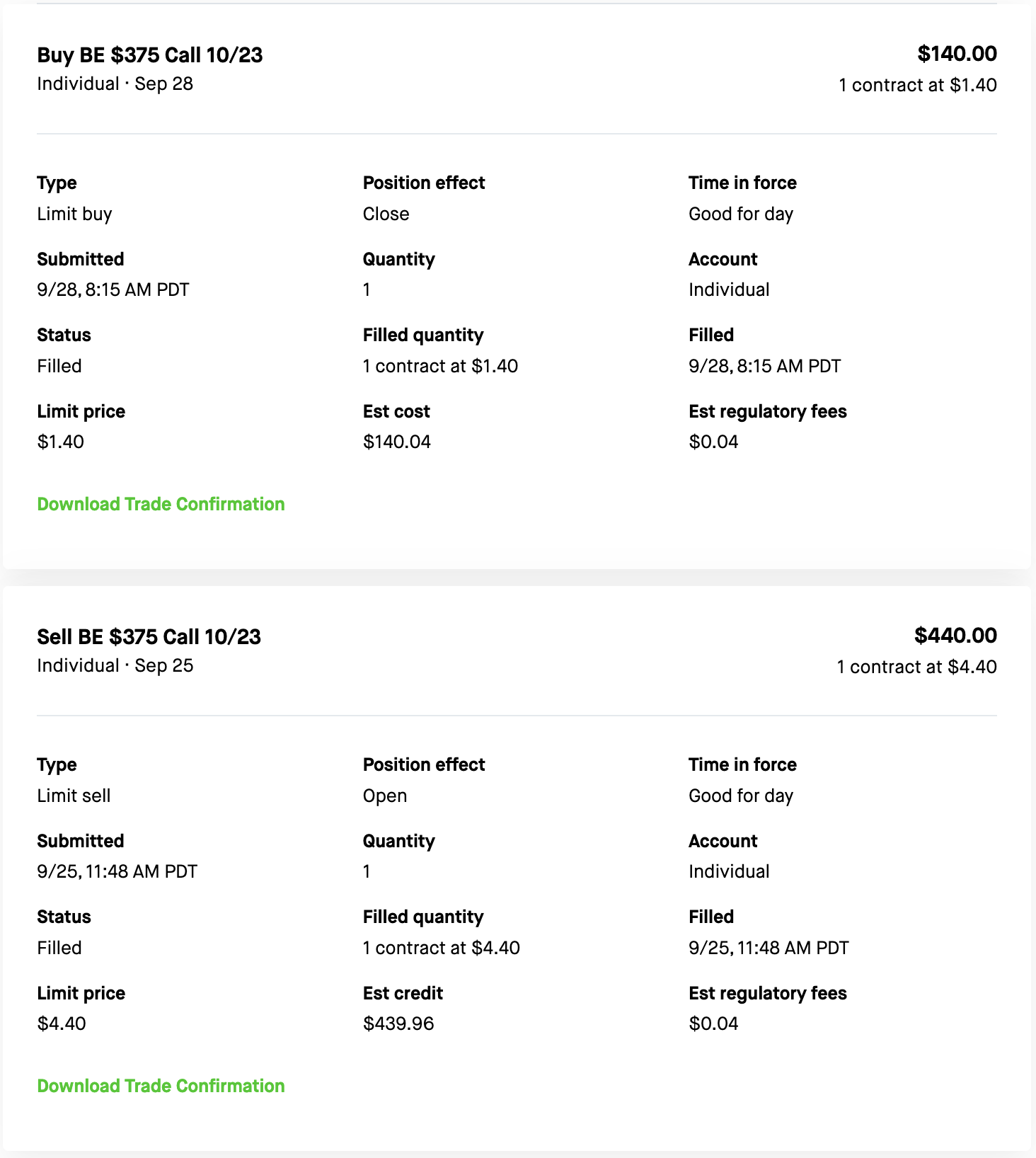
On September 25, I sold one Bloom Energy call with a $375 strike and October 23 expiration for $4.40 a share. BE fell, and on September 28 I bought the call back for $1.40. The $300 difference was a gain on the option, before fees and taxes. Buying it back ended that call’s $375 sale obligation, and I kept the shares. That is the trade in the screenshot below.
The share position and the call must be judged together. A falling stock can make the call profitable while the shares lose more. The call profit alone does not tell you whether the overall decision worked.
I chose to close the BE call after three days rather than wait for expiration. The $300 gain was about 68% of the $440 premium I had collected. I often buy a call back after keeping roughly 70% of its opening premium rather than leave my shares committed for the remaining amount. That is my exit target, not a guaranteed return.
I remained bullish on BE. When it later rose, I sold another call at a price where I was willing to let the shares go. Because I had already closed the first call and waited, that was a new trade, not a roll.
A roll closes the open call and sells a different call as one adjustment. Traders often consider it when the stock reaches or passes the strike but the shares have not been assigned. You might buy back the current call and sell one with a higher strike, a later expiration, or both.
The new sale brings in premium, but closing the old call costs money, often more than you originally received if the stock has rallied. Compare the new premium with the buyback cost: the roll can produce a net credit or require a net payment.
A net credit alone does not mean the whole sequence is profitable, and the new call keeps a cap on your shares. Rolling can happen at other times too. You must close the old call before assignment; while it remains open, assignment is possible.3
Who should skip it?
If losing the shares in a rally would upset you, a premium may not be enough compensation. If you need protection against a large stock decline, the small cushion from one call will disappoint you. If you own highly appreciated shares, assignment can also trigger a taxable sale, and some covered calls affect holding periods. Check that consequence before choosing the strike or expiration.4
What to decide before you sell
- 01
Name the sale price
Choose a strike at which you would be pleased to part with the shares, even if they keep rising.
- 02
Measure the cushion
Compare the premium with a plausible stock decline. $500 helps in the NVDA example, but a large drop still hurts.
- 03
Plan the ending
Decide when you would buy the call back, let it expire, or let the shares go. If one of those outcomes would make you regret the trade, the premium probably isn’t the reason to make it.
For experienced traders
Assignment can happen before expiration. A U.S. equity call seller can be assigned while the call is open, including before the end date. The chance rises for an in-the-money call just before the stock’s ex-dividend date. A stock touching the strike does not automatically sell the shares at that moment.5
An in-the-money call changes the trade. Selling a call with a strike below the current stock price brings in intrinsic value as well as time value. It also makes assignment more likely and can create tax complications on appreciated shares. I would keep that outside a beginner’s first covered call.4
A roll has two prices. Compare the cost to close the old call with the credit for the new one, plus the new strike and extra time at risk. A net credit is possible, not automatic. Repeated rolls can postpone a sale while also keeping a cap on the shares for longer.
Sources
- 1Options Industry Council. Theta
- 2Robinhood. Basic options strategies (Level 2)
- 3Options Industry Council. Options assignment FAQ
- 4IRS. Publication 550: Investment income and expenses
- 5FINRA. Options
All sources checked September 29, 2026.