
Cash-Secured Puts: Get Paid to Wait for a Lower Price
Summary
- A cash-secured put pays you to wait for a stock price at which you already want to buy.
- You keep the premium, but must buy 100 shares at the strike if assigned, even when the market price is lower.
- Sell one only when you want the shares, can afford all 100, and accept the downside of owning them.
A cash-secured put pays you to wait for a price you already want. You keep the payment either way. If the stock drops below your price, you buy the shares at that price, even if they’re worth less by then.
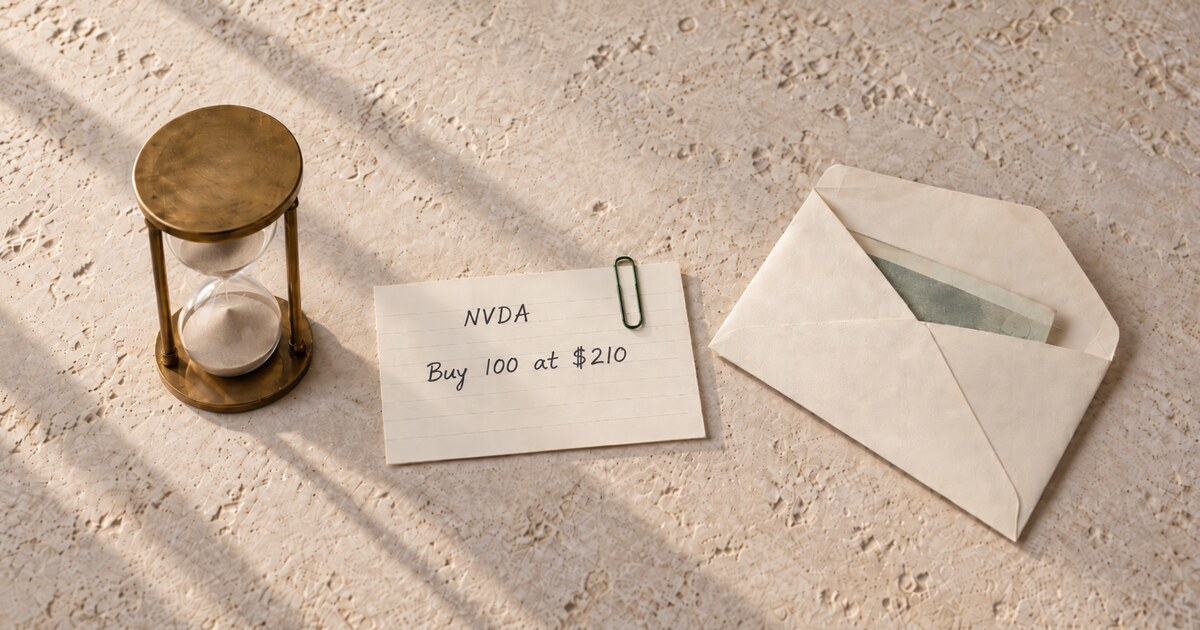
You want to own NVIDIA, just not at $225. It closed at $225.07 on September 25, 2026, and you’d happily buy 100 shares at $210 if it gets there in the next month.
You could buy now and hope. You could set a limit order at $210 and wait. Or you could sell a cash-secured put at $210, collect about $230 today, and wait for the same price you were already waiting for.
I’ve traded options for eight years, and this is one of my two main ways to buy a stock I like. Here’s how it works, what it pays, and when it hurts.
What a cash-secured put is
If options are new to you, how options work, explained with onions covers the basics in ten minutes. Here’s the short version.
Some investors want insurance in case a stock drops. A put is that insurance: it lets its owner sell 100 shares at a set price, the strike, until a set date. When you sell a put, you’re the one offering the insurance. You promise to buy those 100 shares at the strike if the owner wants to sell, and they pay you for that promise up front. That payment is the premium, and you keep it no matter what.
“Cash-secured” means the money to buy the shares sits in your account the whole time. At a $210 strike, that’s $21,000, and your broker holds it until the put ends.
On September 25, the NVDA $210 put ending October 23 sold for about $2.30 a share. One contract covers 100 shares, so you’d collect about $230. That’s about 1% of the $21,000 you set aside, for four weeks of waiting.
What happens next
- NVDA is above $210 on October 23. Nobody wants to sell to you at $210 when the market pays more, so the put ends unused. You keep the $230, and your $21,000 is free again.
- NVDA is below $210 on October 23. The owner uses the put, and you’re assigned: you buy 100 shares at $210. You already have the $230, so your real cost is $207.70 a share. That’s your break-even.
Assignment almost always happens at the end date. Before then, the owner can sell the put for more than they’d gain by using it, so early assignment is rare unless the stock has fallen far below $210.
You can also end the trade early by buying the put back. If NVDA rises, the put’s price falls, and buying it back costs less than you were paid. The difference is your profit. When you sell an option, a falling option price is good news.
You were going to wait for $210 anyway. The put pays you for waiting.
Cash-secured put vs. buying the stock now
Here’s where each choice leaves you on October 23, before fees.
| NVDA on Oct. 23 | Buy 100 shares now at $225 | Sell the $210 put |
|---|---|---|
| $240 | +$1,500 | +$230 |
| $225 | $0 | +$230 |
| $195 | −$3,000 | −$1,270 |
If NVDA rises, buying now wins by a lot. If it stays flat or dips a little, the put wins. If it falls hard, both lose, but the put loses less because you bought lower and kept the $230. You’re giving up a big possible gain for a small, likely one.
What about a limit order at $210? The put works the same way, plus $230. One difference: a limit order can fill on a brief dip. A put usually gets used only if the stock is still below $210 near the end date, so on a quick dip and bounce, you keep the $230 but don’t get the shares.
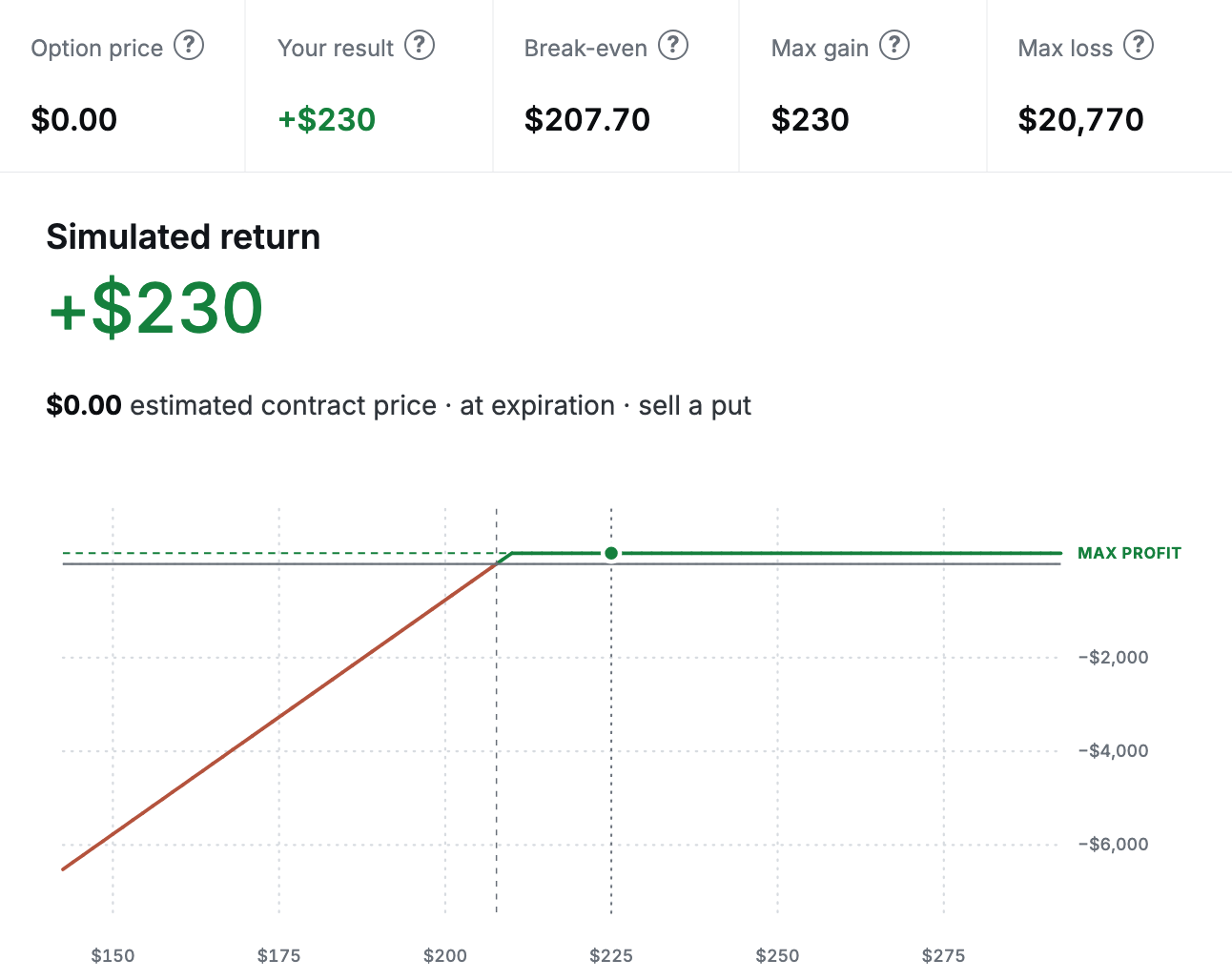
Look at the maximum loss: $20,770. If NVDA went to zero, you’d still have to pay $21,000 for the shares, less the $230 you kept. You can try your own numbers in the options simulator.
What if the stock falls?
Take the last row. NVDA drops to $195, you’re assigned, and you pay $210 for shares worth $195. After the $230 premium, you’re down $1,270. That’s better than the $3,000 loss from buying at $225, but it’s still a loss.
So only sell a put on a company you’d be glad to own for years at that strike. If you’re assigned, you have good options:
- Hold the shares. You own a company you wanted at a price you chose.
- Sell a covered call. Someone pays you for the right to buy your shares at a higher price.
- Buy more. If you still believe in the company, a lower price is a better entry.
If you’d panic and sell at the bottom, don’t sell the put.
How to pick the strike and the end date
The strike. I pick a strike about 5% to 15% below today’s price, where the premium comes to about 1% to 2% of the cash I’m holding.
A bigger premium means a bigger risk. On September 25, a put like this paid about 0.8% of the cash on Apple and about 3.2% on Bloom Energy. Bloom pays four times as much because the market expects it to swing much more, so it can also fall much further.
The end date. I sell puts about a month out. An option loses value as its end date gets closer, and for a put near the stock’s price, the loss speeds up in the final month.
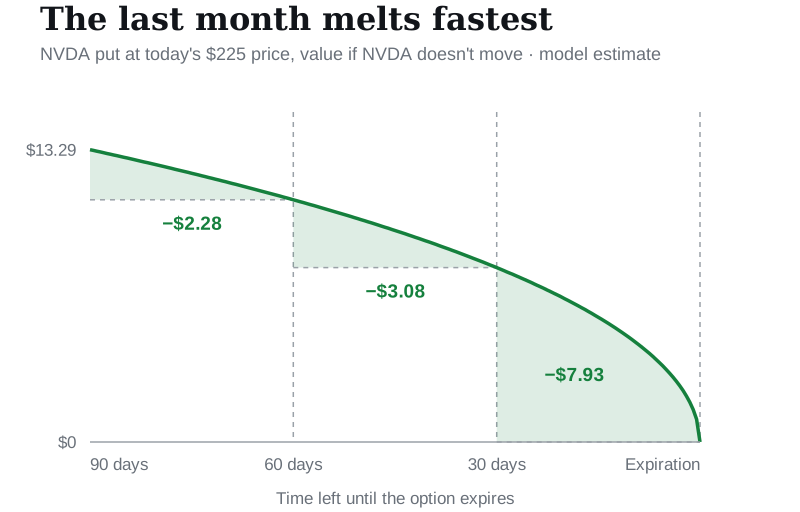
That melting value is what you collect as the seller. At the same odds of assignment, a one-month NVDA put paid about 8 cents a day, and a three-month put about 5 cents.
I don’t wait for the last few cents. Once I’ve kept about half the premium, I buy the put back and sell a new one.
A real one: my IonQ put
Here’s a trade I have open. On September 23, I sold one IonQ $40 put ending October 16 for $1.67 a share, or $167.
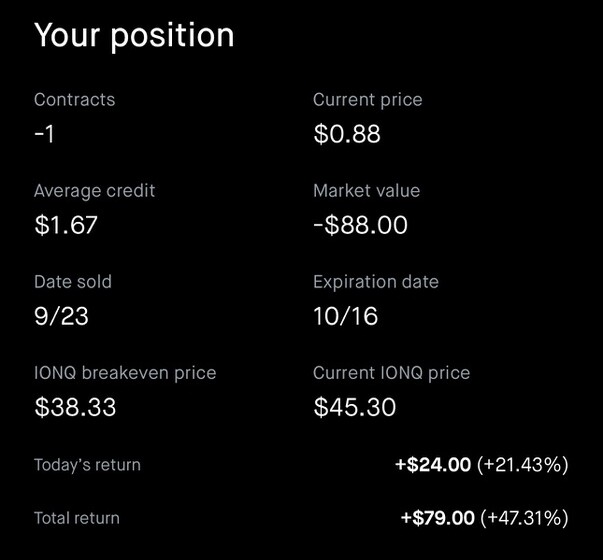
- Cash held: $4,000, enough to buy 100 shares at $40.
- Premium: $167, or 4.2% of the cash in 23 days.
- Break-even: $38.33.
Two days later, IonQ had risen to $45.30. The put I sold for $1.67 now cost only $0.88 to buy back, so I was up $79.
That 4.2% is much higher than the usual 1% to 2%. IonQ is a young quantum computing company, and the market expects big swings, so its puts pay more. It’s one of the riskier holdings in my portfolio, owned for exposure to a technology I think has a long future, and I’d be glad to own it at $38.33. If it fell to $30, I’d hold shares worth $3,000 that cost me $3,833, and I’d need to be at peace with that.
In 2026, I sold 94 cash-secured puts. Seven were assigned, and I closed almost all of the rest at a profit.
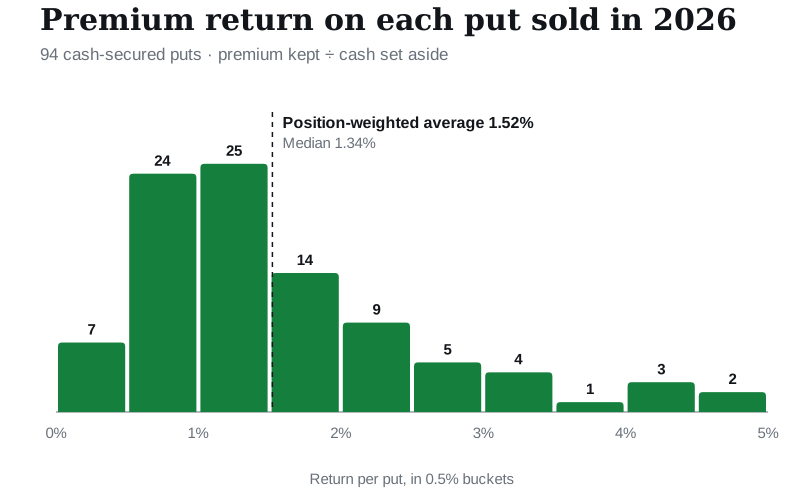
This chart measures premium income, not my portfolio return. It does not include what happened to shares after assignment.
Are cash-secured puts worth it compared with T-bills?
If you’ve made work optional and still invest actively, as I do, cash-secured puts can be one way to enter stocks you want. They have been part of my plan. The premium can feel like income, but it is payment for taking the stock’s downside. Every put is a promise to buy a stock that can fall.
The safe home for idle cash is a Treasury bill fund. SGOV, which holds my cash reserve, yielded about 3.67% a year in late September 2026: about $306 a month on $100,000, with almost no risk.1
Puts on the same $100,000 at my 2026 average, about 1.52% a put and roughly one a month, would bring in about $1,520 before any gain or loss on shares after assignment.
That extra money is payment for risk. A short-term Treasury fund is not exposed to the same stock-specific 20% drop. The stocks behind your puts are, and a 20% drop on $100,000 of assigned stock is a $20,000 paper loss, about a year of premium.
Who should skip it
- You’d be unhappy to own the stock at the strike.
- You might need the cash before the put ends.
- A 20% drop in a stock you own would push you to sell.
- You want all of the gain if the stock rallies. Buy the shares instead.
What to do with this
- 01
Start small
My first puts were on a stock cheap enough that one contract needed under $500 of cash. Many brokers also offer paper trading, so you can practice with pretend money first.
- 02
Pick the stock first, then the put
Choose a company you want to own and the price you’d pay. The put is only a better way to wait for that price.
- 03
Decide your plan before you sell
Know whether you want the shares, only the income, or both. That decides whether you let the put end, buy it back, or accept the shares.
If you’re assigned shares, selling covered calls on them is the natural next step, and that put-then-call sequence is the wheel strategy. My other way into a stock I like is a LEAPS call, a long-dated option that moves much like the stock for about half the cash.
For experienced traders
Delta. Brokers show delta next to each option. For a put you sell, it’s a rough estimate of the odds of finishing below the strike. I sell at about 0.15 to 0.20. On September 25 the NVDA $210 put was about 0.20 delta. The $215 put, $10 below the $225 price, was about 0.27.
The same delta pays differently. About 0.20-delta puts ending October 23, midpoint quotes at the September 25 close. Deltas and implied volatility are my estimates from those prices.
| Stock | Price | Strike | Premium | Implied volatility | Premium / cash |
|---|---|---|---|---|---|
| Apple (AAPL) | $341.07 | $325 | $2.46 | 23% | 0.76% |
| NVIDIA (NVDA) | $225.07 | $210 | $2.30 | 32% | 1.10% |
| IonQ (IONQ) | $45.48 | $40 | $1.11 | 67% | 2.77% |
| Bloom Energy (BE) | $288.70 | $250 | $8.07 | 76% | 3.23% |
Decay on an out-of-the-money put is flatter. The chart above uses a put at the stock’s price, where the last month clearly loses the most. The $210 put loses its value more evenly: about $2.00, $2.48, and $2.50 across the three 30-day blocks. The case for about a month is the daily rate at the same delta ($0.08 against $0.05 for 90 days) and the chance to reset the strike monthly.
Closing at 50% to 70%. With two weeks left and NVDA unchanged, the $210 put would be worth about $0.91, so about 60% of the premium is kept in half the time. The rest takes two more weeks with the same $21,000 at risk.
Red days. A sector or market sell-off lifts implied volatility and premiums. On a company you’ve already researched, that’s a good day to sell a put further below an already lower price.
Rolling. Buy back this month’s put and sell a later one, often at a lower strike, for another premium. If you’re eventually assigned, your cost is the strike minus every premium collected.
Puts backed by margin. Some brokers let you sell puts without holding the full cash. The broker holds part of the strike value, and no interest is charged until you’re assigned and actually borrow. It’s no longer a cash-secured put: it’s an uncovered put that needs a higher options approval level, the broker can demand cash or close positions when stocks fall, and assignment becomes an interest-bearing loan.2 Know how many shares you could be assigned in a sharp drop, and how you’d pay for them, before trying it.
Sources
All sources checked September 25, 2026.