
How Options Work, Explained With Onions

Summary
- An option gives its buyer a right and its seller an obligation at a fixed price before a deadline.
- The premium pays for that contract, while price, time, volatility, and the Greeks determine how its value changes.
- Understand the obligation and maximum loss before trading; for most people, regular index investing remains the simpler default.
Imagine you run a restaurant. A sack of onions costs $100 today, and you know you will need another one in two months. You want the right to buy that future sack for $100 even if prices jump.
Someone offers you that right for $5. The $100 is the strike price. The $5 is the premium. The contract ends in two months.
If a sack costs $110 then, you can buy it for $100. That saves you $10. Subtract the $5 premium and you are ahead by $5, before costs.
If a sack costs $90, you can ignore the contract and buy it in the market. You still spent $5 on the option, so your total cost is $95. The option gave you a choice, and you used the cheaper one.
I have traded options for eight years, and they are my main way to enter and exit trades. They have made me good money, and they can hurt you fast if you do not understand the contract. For most people, a broad, low-cost index fund is the better move. Options are optional. If they still make you curious, learn the contract first, and keep a safety net like a year of expenses I can reach before risking money you may need.
What the seller promises
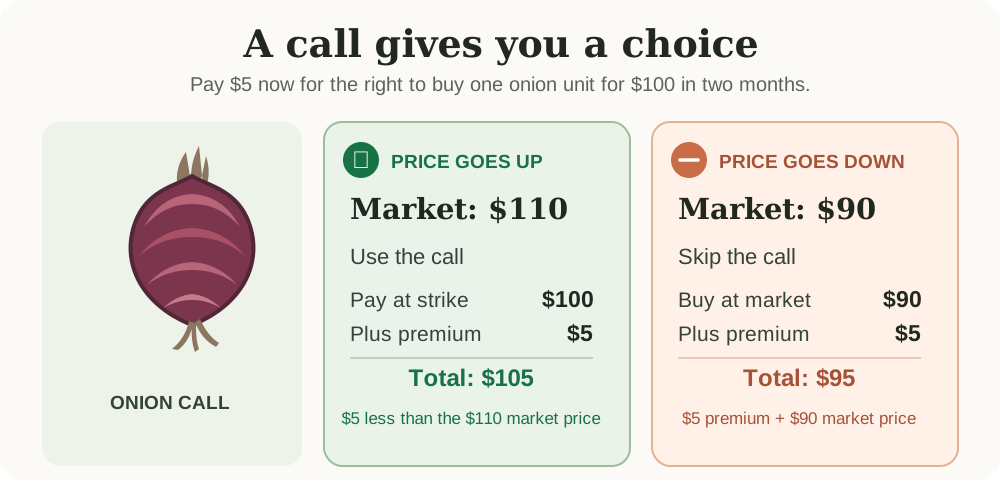
That’s a call: the right to buy at the strike price. In this example, it caps your total purchase cost at $105, including the premium.
What does the seller get out of this? Your $5, upfront. In return, they promise to sell you the sack for $100 if you use the contract. If the market stays below $100, the call expires unused and the seller keeps the premium as profit. If the market reaches $110 and the seller does not own the onions, they may have to buy them for $110 and sell them to you for $100. After keeping your $5 premium, they are down $5, before costs. If onions keep climbing, that loss keeps growing.
So how do the buyer and seller land on $5? They are pricing what the contract might be worth. In a real market, the time left, expected price swings, and other factors all affect the premium.
Why onions?
U.S. onion futures have been banned since 1958. This example is imaginary, and futures are a different kind of contract. The CFTC’s history1 confirms the ban is still in effect.
A put is a price floor
Now imagine you already own onions and worry the price might fall. You pay $5 for the right to sell them for $100.
If the market price drops to $90, you can still sell for $100. After paying $5 for the put, you receive $95 overall. That’s $5 more than selling at the market price. If onions go up to $110, sell them in the market and let the put expire. You lose the $5 premium, but you don’t have to use the option.
That’s a put: the right to sell at the strike price. In this example, it creates a $95 floor after the premium.
In both examples, the buyer has a right. The seller gets paid the premium and takes on an obligation if the buyer exercises and the seller is assigned. The buyer can lose the whole premium. The seller keeps the premium either way, but it may only cushion a larger loss.
The buyer pays for a choice. The seller gets paid for accepting an obligation.
See the payoff change
The call buyer breaks even at $105: $100 to buy the onion, plus the $5 premium. The put buyer breaks even at $95: selling for $100 just covers the $5 premium. Those are outcomes at expiration, not predictions. A call seller’s losses can keep growing as the price rises.
Open the options simulator to see all four sides of the trade. Move to expiration for the exact payoff, or leave time remaining to estimate how the option’s value may change before then.
The estimated option price matters before expiration because the contract can still contain time value. At expiration, the curve becomes the exact contract payoff.
The onion example uses one unit to keep the math simple. A standard U.S. stock option usually covers 100 shares, so a $5 quoted premium commonly costs $500 for one contract. Adjusted contracts and other products can differ.2
The same price can mean different things
Suppose onions rise to $107 soon after you buy the two-month call. The right to buy for $100 now saves $7, so the call has $7 of intrinsic value. Why might someone pay $8 for a right that saves only $7 today? There is still time for onions to rise further. That extra $1 is time value. If you sell the option for $8 after paying $5, you make $3 per sack, before costs.
If onions first reach $107 on expiration day, there is no time value left. The call is worth $7, so your profit after the $5 premium is $2 per unit.
| When onions reach $107 | Option value | Result after $5 premium |
|---|---|---|
| Soon after buying, in this example | $8 | +$3 if you sell |
| At expiration | $7 | +$2 |
The market price of an option also depends on how much movement people expect. That expectation is called implied volatility. If traders expect bigger swings, calls and puts often cost more. So you can guess the direction right and still lose money if the move is too small, too late, or volatility drops.
Five Greeks, five clues
Options have five common gauges called the Greeks. You don’t need to memorize them yet.
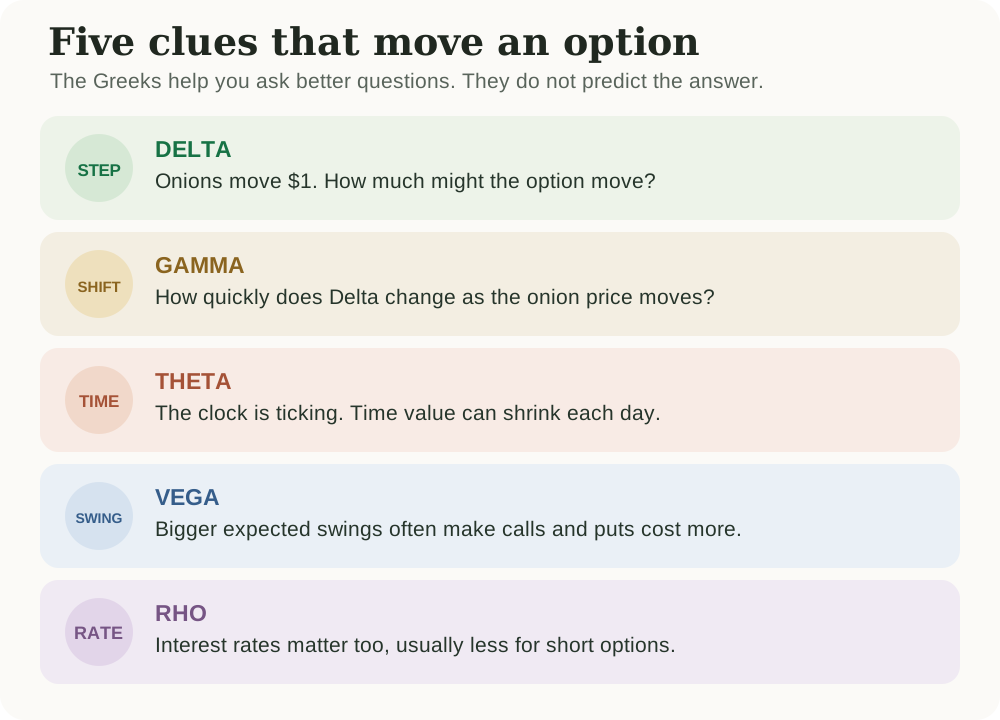
One example makes Delta concrete. A delta of 0.5 means a $1 rise in onions may add roughly 50 cents to the call’s price, with everything else unchanged.
All five readings move as the market changes. They show what your trade depends on, but they do not predict what will happen. The Options Industry Council’s guide to the Greeks3 explains them in more detail.
Before you trade
Read the contract details before trading. Options can have different sizes, exercise rules, and ways of settling. The SEC’s introduction to options4 and the OCC’s options risk document5 explain the rights and risks.
An app can draw a tidy payoff chart, but a real trade still depends on the price you can get in or out, what happens at expiration, and how much you could lose. In my first options trade story, I learned that a position showing a gain on screen is not always easy to close.
That’s enough to read an option ticket without treating it like alphabet soup. You now know what the buyer pays for, what the seller promises, and why getting the direction right may still not be enough.
Options have worked well for me, but they demand time and care. If you want to try them, learn the contract first and decide how it fits into your portfolio. For a real Robinhood trade, see how cash-secured puts work, where I walk through an IonQ put I sold. My other way into a stock is a LEAPS call, a long-dated option that moves much like the stock for about half the cash.