
LEAPS Calls: Own a Stock’s Moves for Half the Cash

Summary
- A LEAPS call is an option to buy a stock at a fixed price up to about three years out. Bought deep in the money, it tracks 100 shares for roughly half the cash.
- The lower cash requirement comes with an expiration date, time decay, and the possibility of losing the entire premium.
- Use LEAPS only when you understand the strike, delta, time value, and what must happen before expiration.
On September 25, 2026, NVIDIA closed at $225.07, so 100 shares cost $22,507. A call option on NVIDIA that runs to January 2028 cost about $10,693, and it moves about 92 cents for every $1 the stock moves. That is a LEAPS call: an option to buy the stock at a fixed price up to about three years out, bought deep in the money so it tracks the shares for about half the cash.
The catch: if NVIDIA is below $130 in January 2028, that call is worth nothing, and you lose all of it. Shares would still be yours. And even if the stock doesn’t move, you lose the part of the price that pays for time.
LEAPS calls are one of my two ways into a stock I believe in, and I’ve used them for about six years. The other way is cash-secured puts. Here’s how they work, why I buy them the way I do, and where they’ve gone wrong for me.
What a call is
If options are new to you, how options work, explained with onions covers the basics. You buy them in a regular brokerage account once the broker approves you for options trading.
One thing to know before the numbers: option prices are quoted per share, but one contract covers 100 shares. A call listed at $106.93 costs $10,693.
A call gives its owner the right to buy 100 shares at a set price, the strike, until a set date. You pay a premium up front for that right. If the stock ends up above the strike, the right to buy below the market is worth money. If it doesn’t, you let the call expire and lose what you paid.
Think of it as paying a seller to hold a price for you. If you buy, you pay the price you locked in. If you walk away, the seller keeps your fee.
Why most calls are bets
Most people meet options as short bets. Say you pay $1,343 for a NVIDIA call with a $225 strike that ends November 20. If NVIDIA is at $250 that day, you make $1,157. At $225 or lower, you lose all $1,343. NVIDIA has to rise about 6% in eight weeks just to break even, and the call loses about $12 of value every day the stock sits still.
LEAPS calls are built to avoid that. To see how, you need the two parts of an option’s price.
The two parts of an option’s price
- Intrinsic value is what the option is worth if you used it right now: the stock price minus the strike, if that’s positive. A $130 call on a $225 stock has $95.07 of intrinsic value.
- Time value, also called extrinsic value, is everything else: what you pay for the chance the stock moves further before the end date. More time and bigger expected swings mean more time value. It shrinks to zero by the end date.
The two-month $225 call is almost entirely time value, which is why it can go to zero. The January 2028 $130 call is mostly intrinsic value: $95.07 of its $106.93 price. Only $11.86 is time value: what you pay to lock in the right to buy at $130 until January 2028.
A deep in-the-money call is mostly stock value with a small time premium on top. That’s why it moves like the stock.
LEAPS vs. shares: why I buy deep in the money and far out
Delta is how much an option’s price moves when the stock moves $1. A delta of 0.9 means about 90 cents. A short-dated call with a strike near today’s price has a delta of about 0.5, so it only half follows the stock.
Deep in the money means a strike well below today’s price. I aim for a delta of about 0.9. Most of the price is intrinsic value, so there’s little time value to lose. The stock can fall a fair way before the call is worthless, but in percentage terms you lose faster than the shares do.
Far out means a long time until the end date. LEAPS is the exchange’s name for options, calls or puts, that last up to about three years.1 The January 2028 $130 call loses about $3 a day to time, compared with about $12 for the two-month call. Both figures are for one contract. And it gives the company more than a year to do what you expect.
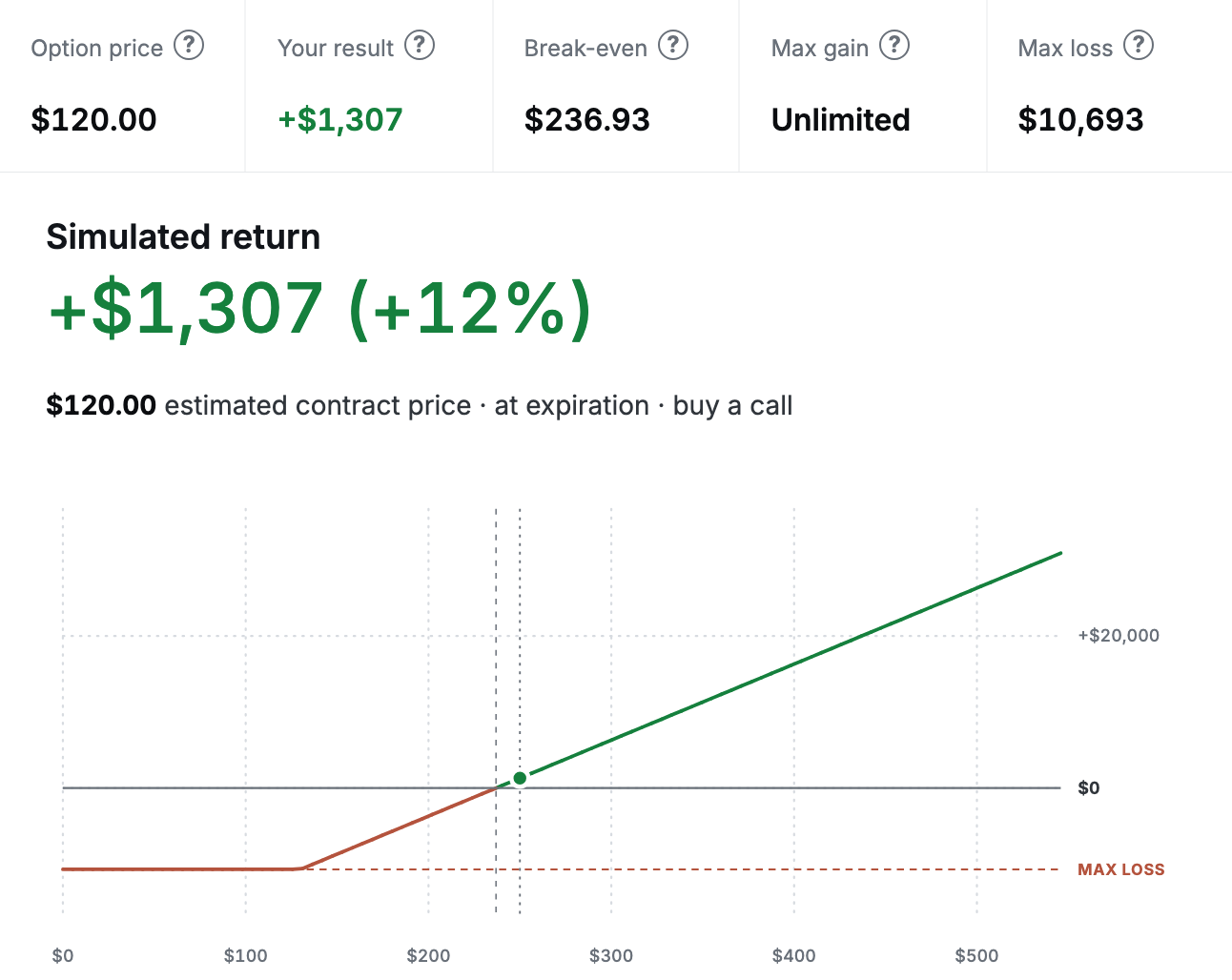
Here’s how 100 shares compare with one or two of these calls if you held them to January 21, 2028, before fees. Read across a row to compare the three at the same NVIDIA price.
| NVDA in Jan. 2028 | 100 shares ($22,507) | One call ($10,693) | Two calls ($21,386) |
|---|---|---|---|
| $300 | +$7,493 (+33%) | +$6,307 (+59%) | +$12,614 (+59%) |
| $250 | +$2,493 (+11%) | +$1,307 (+12%) | +$2,614 (+12%) |
| $225 | about $0 (0%) | −$1,193 (−11%) | −$2,386 (−11%) |
| $175 | −$5,007 (−22%) | −$6,193 (−58%) | −$12,386 (−58%) |
| $125 | −$10,007 (−44%) | −$10,693 (−100%) | −$21,386 (−100%) |
Look at the $225 row: the stock didn’t move, and the call still lost 11%. That’s the time value melting away. On a big move, the calls swing about twice as far as the shares in either direction, and below $130 they’re gone. Two calls have the same percentages as one; they double the dollars.
One call behaves like the shares minus about $1,190 of time value, for half the cash. The other half can sit in a Treasury bill fund (short-term government debt, close to cash) and, if rates hold, earn back about half of that $1,190.
Two calls cost about the same as the shares and double the result both ways. At $300 you make almost twice as much. At $125 you lose everything, while the shares would still be worth $12,500. That’s leverage, and it’s the part that hurts people.
Try your own strike and date in the options simulator.
What it looks like in my account
Here’s one I hold. On July 23, I bought one Google call with a $200 strike running to December 15, 2028. The strike put the delta near 0.9, and the long date gives the trade time to work with little decay per day.
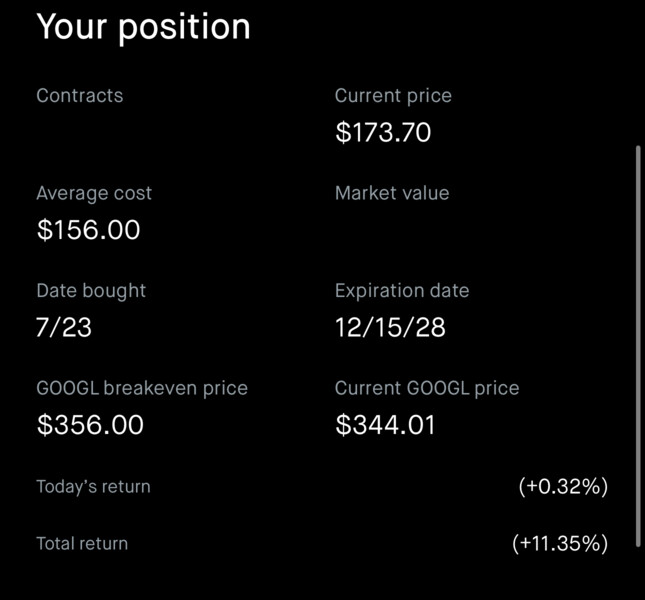
- Cost: $156.00 a share.
- Break-even at the end date: $356.
- Delta: about 0.92.
The call was worth about $173.70 a share after the September 25 close, up from the $156 I paid. With Google at $344.01, $144.01 of that is intrinsic value: the gap between the stock price and my $200 strike. The other $29.70 or so is extrinsic value: what it costs to keep the right to buy at $200 until December 2028. That’s about 9% of the stock price for a little over two years.
Here’s the honest part. The call cost about half as much as the shares, so you might expect it to earn about twice the percentage. It hasn’t. Google closed at $317.69 the day I bought and was near $344 after September 25, up about 8%. My call is up about 11%: ahead of the shares, but well short of double.
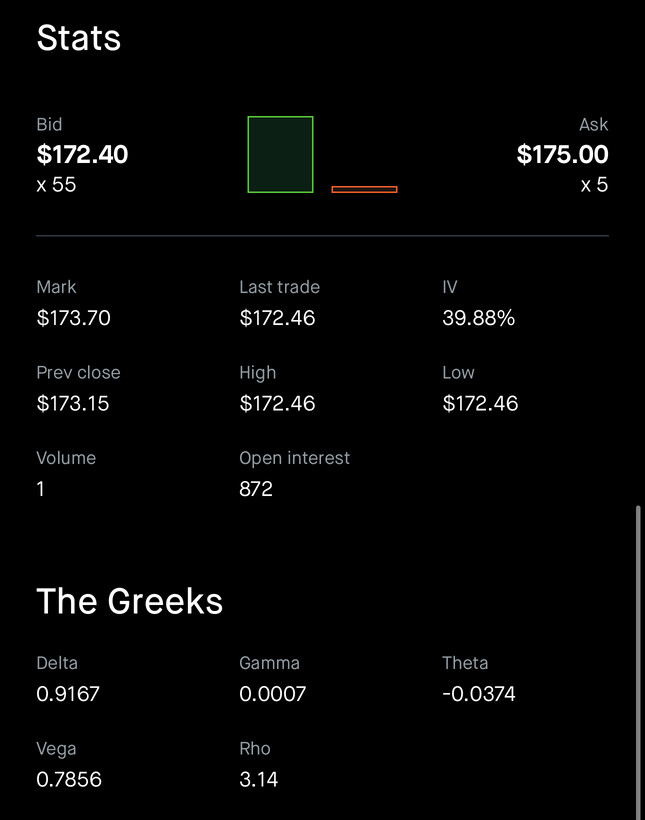
Most of the gap is time value melting over two months. The market also likely expects smaller swings in Google than it did in July, and that lowers what anyone will pay for time. On top of that, trading has a cost: buyers were offering $172.40 while sellers wanted $175, so you tend to buy a little high and sell a little low. LEAPS calls pay off on big moves over long stretches, not small moves over a few weeks.
When it goes wrong
You can lose a lot well before the end date, too. I still make mistakes. I once bought an at-the-money LEAPS call, one with a strike near the stock’s price, right before an earnings report. The stock dropped about 20%, and the call lost about half of what I paid.
Two things made it worse. An at-the-money call is almost all time value, so a drop wipes out a much bigger share of what you paid. And after earnings, the market expects smaller swings, so time value shrinks even more. Buying right before the report set up both.
How I manage them
I pay cash for LEAPS calls. I hold them and sell when I think the stock has peaked, and I take profits along the way. How much and when depends on my plan for that stock and how big the position is.
In 2026, I’ve closed 75 LEAPS calls after holding them for about four months on average. Of those, 65 made money. The four biggest losses were 94% to 100%. I closed all four on one day in August to harvest the tax losses.
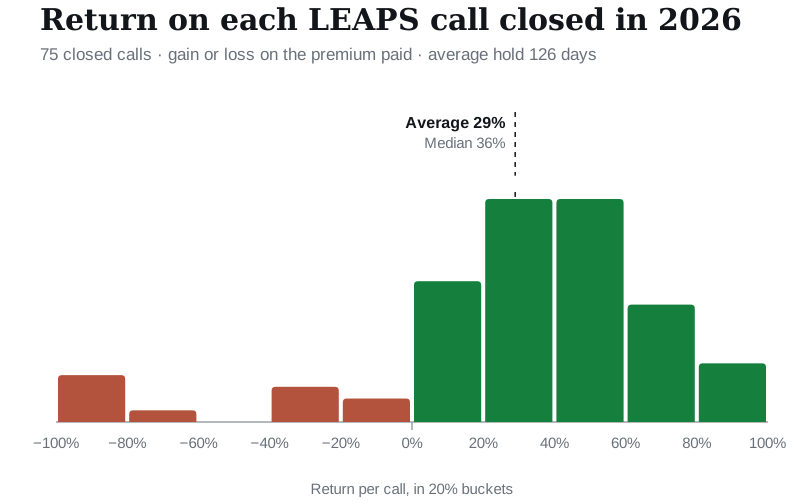
This is a distribution of closed calls, not my portfolio return. It leaves out positions that are still open and counts each call equally, regardless of how much cash I put into it.
When I close one, I sell the call rather than exercise it, meaning use it to buy the shares. Take the two-month $225 call from earlier ($1,343): if NVIDIA jumped to $250 a week later, exercising (buying the shares at $225 and selling them at $250) would net about $1,157. Selling the call itself would net about $1,629, because it still carries time value. Exercising throws that away.
Who should skip it
- You’d be upset to lose everything you put into the call.
- You don’t have a long-term view on the company.
- You’re tempted to buy two calls for the price of the shares and aren’t ready for twice the loss.
- You want dividends. Call owners don’t receive them.
- You already own shares and want to name a price at which you would sell them. That is a covered call.
What to do with this
- 01
Go deep and go long
A delta around 0.9 and the furthest end date available keep time value small.
- 02
Spend no more than you would on the shares
One call for half the cash, with the rest in Treasury bills, caps your worst case at what you paid for the call. Two calls double it.
- 03
Sell it, don’t exercise it
Unless you want the shares, selling a winning call keeps its time value.
For experienced traders
LEAPS calls vs. cash-secured puts.
| Cash-secured put | Deep in-the-money LEAPS call | |
|---|---|---|
| How you enter | Wait for a lower price | Own the move at today’s price |
| Premium | You’re paid | You pay |
| Cash tied up | The full strike price | About half the share price |
| Best case | You keep the premium | No cap |
| Worst case | You own shares worth much less | You lose everything you paid |
| Suits | Patient buyers who want shares lower | High conviction, long view |
Choosing the strike. NVDA January 21, 2028 calls at the September 25 close, bid-ask midpoints. Deltas are my estimates from those prices.
| Strike | Price | Delta | Time value | Cost / share price |
|---|---|---|---|---|
| $125 | $111.73 | 0.92 | $11.66 | 50% |
| $130 | $106.93 | 0.92 | $11.86 | 48% |
| $140 | $99.58 | 0.89 | $14.51 | 44% |
| $150 | $91.70 | 0.87 | $16.63 | 41% |
Lower strikes cost more but carry less time value and track the stock more closely.
The Google comparison, precisely. One contract, bought on July 23 at $156 a share, a day Google traded between $314.90 and $324.49. Measured from the close, the stock gained about $26.30 a share. Because the call is deep in the money, its intrinsic value rose by that same amount, while its time value fell from about $38.30 (if I bought near the close) to about $29.70, for a net gain of $17.70 at the $173.70 mark.
The Greeks on my Google call. Theta of −0.0374 is about $3.74 a day per contract. Vega of 0.79 means a one-point drop in implied volatility costs about $79 per contract, which is how calmer expectations can offset a rising stock.
Margin. FINRA lets a broker lend against a bought option only when it has more than nine months left, and then only 25% of its value; shorter options must be paid in full.2 I pay cash.
Taxes. A LEAPS call held more than a year can qualify for long-term capital gains when sold. Tax isn’t what drives my exits, but I do sell deep losers to harvest the loss when a stock’s near-term outlook is bleak. The wash-sale rule covers options: if you sell shares or a call at a loss and buy a call on the same stock within 30 days before or after, the loss can be deferred rather than taken that year.3
Sources
All sources checked September 25, 2026.