
The Wheel Strategy: How It Works and When It Fails

Summary
- The wheel pays you for two decisions: waiting for a stock at your buy price, and offering it at your sell price. Neither payment protects you if the stock falls hard.
- In the example, $500 in premiums is the full-cycle gain at the $90 call strike, and the whole position breaks even at $85.
- Pick a stock you would own through a slump and name both prices before selling either option; stop the cycle if your view of the business changes.
I’ve traded options for eight years, and the wheel is how I combine two trades I already use: a cash-secured put to buy a stock and a covered call to sell it. I think of it as two prices: one I’d be glad to buy a stock at, and one I’d be glad to sell it at. Someone pays me a premium for committing to each. If either price would make me regret the trade, the premium doesn’t fix the decision. The stock and those two prices come first.
Both payments are real. Neither protects you if the stock falls hard, and that is where the wheel fails.
If options are new to you, start with how the contracts work, explained with onions.
How does the wheel strategy work?
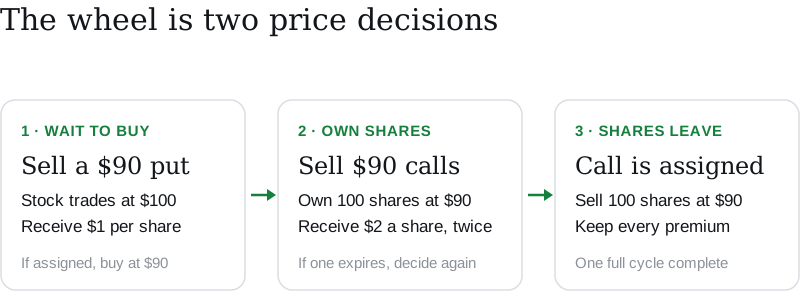
Suppose a stock trades at $100, but you’d be comfortable buying 100 shares at $90. You sell one $90 cash-secured put for an illustrative $1 per share. The $90 is the strike: the price you must pay if the put is assigned, meaning its buyer exercises it. One standard equity contract covers 100 shares, so you receive $100 and set aside $9,000 to buy the shares if assigned.
If the put expires unused with the stock above $90, you keep the $100 and can decide whether you still want to buy the stock. If the stock falls to $85 and the put is assigned, you pay $9,000 for 100 shares then worth $8,500. After the $100 premium, your effective purchase price is $89 a share, and you’re down $400 on the combined position at that moment. Buying below the original $100 price helped, but you still lost money. That put is the first part of the wheel.
Now you own the shares. Suppose you sell a $90 covered call for an illustrative $2 per share, or $200. If the stock stays below $90 and the call expires unused, you keep the shares and that $200. You could choose to sell another call. For the example, suppose a second $90 call also pays $200.
If the stock rises to $95 while that second call is open, your shares may be called away at $90. You keep all three premiums. That put-then-call sequence is the whole wheel, as the Options Industry Council describes it.1 The complete cycle looks like this:
| Cash flow for 100 shares | Amount |
|---|---|
| Buy shares after put assignment | −$9,000 |
| Receive put premium | +$100 |
| Receive two call premiums | +$400 |
| Sell shares after call assignment | +$9,000 |
| Total gain | $500 |
Those $2 calls are teaching numbers, not available quotes or a promise that the same call will pay that much twice. The premiums lower the economic break-even to $85 a share in this example. They are not the whole result: you must also count what happened to the stock. If the stock were still at $85 after both calls expired, the $500 in premiums would be offset by a $500 paper loss on the shares.
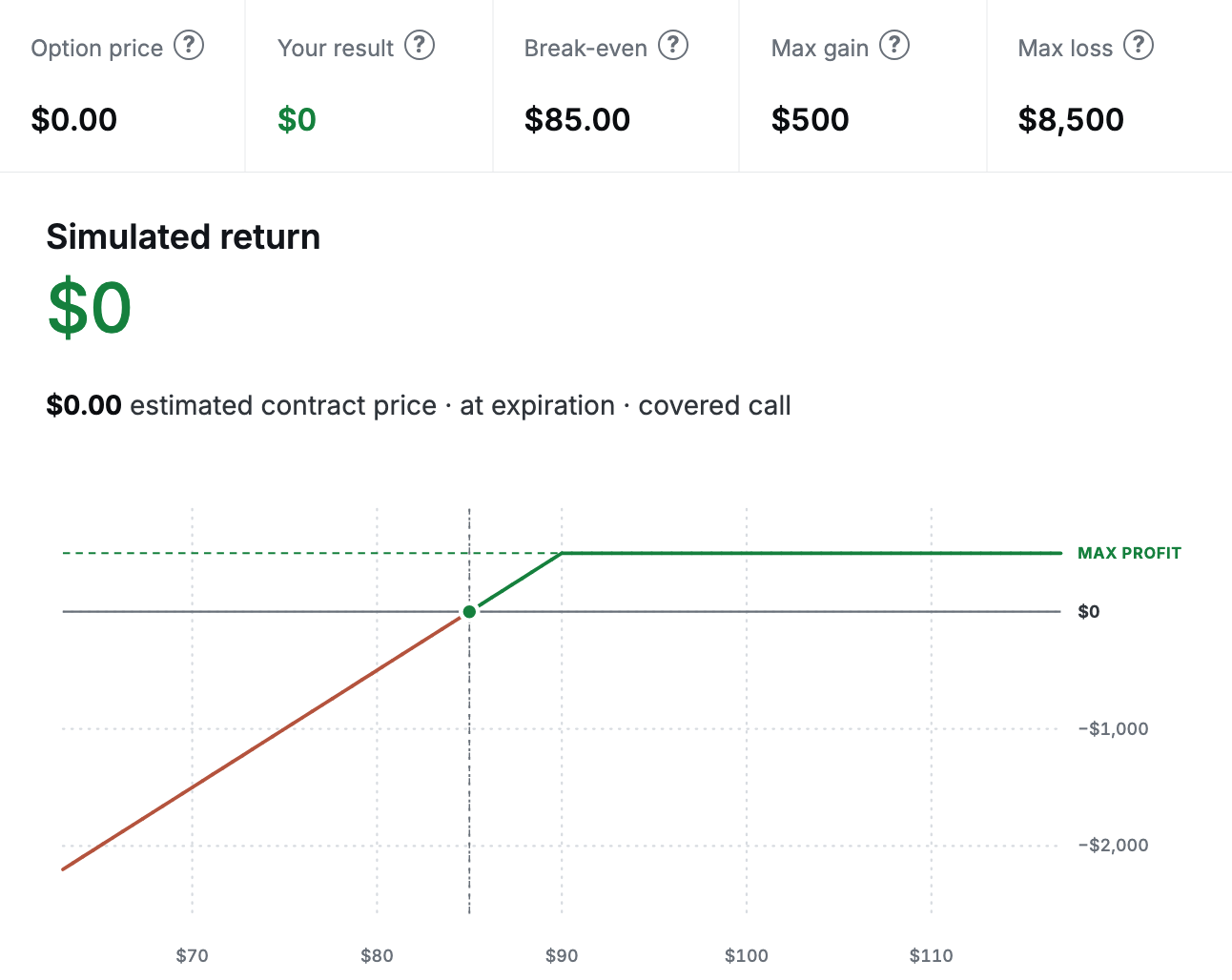
Try your own cost, strike, and premiums to see where the wheel breaks even and where the call caps the gain.
If the stock rises past $90 while your call is open, the covered call also costs you the gain you would have kept by holding the shares. That is the price of the $400 in call premiums.
How do you lose money with the wheel?
The hard case is a stock that keeps falling after your put is assigned. You agreed to pay $90 even if the market price has dropped far below it. A covered call’s premium may soften that loss, but it cannot make the shares safe. The Options Industry Council warns2 that neither half of the wheel meaningfully protects against a sharp stock decline.
Suppose the stock falls to $60 instead of recovering. Even after collecting $5 per share in put and call premiums, the shares would be worth $3,000 less than you paid for them. The whole position would be down $2,500 if you still held the shares. You could sell another call, but that would not make the $2,500 loss disappear.
The $9,000 you set aside for the put is at risk. If the stock went to zero after assignment, the put premium alone would leave you with an $8,900 loss. If you had also collected both illustrative $2 call premiums, the total loss would still be $8,500. Those are the maximum losses for those specific cash-secured examples.
Trade Desk offers a real price path for that risk. The put and calls described around it below are only an illustrative example, not a trade of mine. Its shares closed at $22.38 on April 15, 2026, and at $12.10 on October 1, a decline of about 46%. The chart shows actual daily closes, not an option trade.34
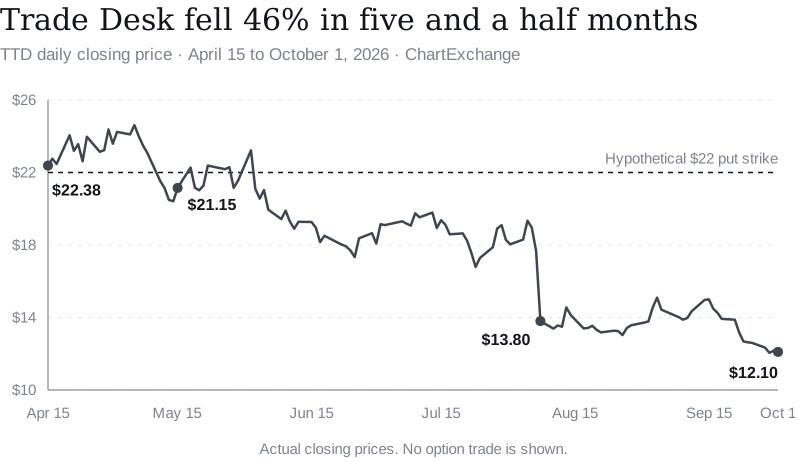
Imagine selling a $22 put in mid-April that expired May 15. TTD closed at $21.15 that day. If the put were still open and assigned, you’d buy 100 shares for $2,200. At the October 1 close those shares would be worth $1,210, a $990 loss on the shares before premiums. To erase that loss through options alone, you’d need $9.90 per share in net premiums. I have not used a historical put quote or assumed any calls filled.
At $12.10, a $22 covered call is far above the stock price and might pay little. A lower call strike could bring in more, but it could also force a sale below the $22 share purchase price if the stock rebounded. Waiting with the shares leaves you exposed to further declines. None of those choices restores the old price by itself.
Can you live off the wheel strategy?
Repeated premiums can help pay expenses in a good stretch. I can see the appeal. But you might collect them for months, then take a stock loss that outweighs them. That makes the wheel a poor substitute for a paycheck.
I would measure a wheel by the whole position: option premiums, the value of shares still held, the gain or loss when shares are sold, and the cash committed over time. A record of premiums alone can make a losing stock position look successful. The question for me is whether I still want the business at the price I’m obliged to pay, and whether I’d accept the sale price on a call.
How I choose the stock and the trade
Five habits, in the order I apply them.
- 01
The business first
A high-quality business with positive momentum and an outlook I like, and a put strike where I’d be happy to own it. If assigned, I may hold the shares until they’re back above what I paid, then pick a call strike where I’d be pleased to sell.
- 02
The day
Puts on a red market day when nothing adverse has happened to the company; calls on a green day or after the stock has run up. My preference, not a rule or a guarantee of better prices. A sell-off can continue, and I can be wrong about the business.
- 03
Then the option
The strike sets where I may have to buy or sell, the expiration sets how long that obligation lasts, and an unusually large premium often means the market expects a sharp move. I usually start four to six weeks out.
- 04
Plan for assignment
Some traders keep selling puts to avoid assignment. I plan for it: the price can fall through my strike, and then I need to be willing to own the stock. The put is my entry and the call is my exit, not a wheel to keep turning.
- 05
Closing early
I sometimes buy back an option after keeping around 70% of its premium, then reassess the stock and any new trade. Closing costs money, and the next premium may need a less attractive strike or more time at risk.
Who should skip it?
- You could not own 100 shares through a steep decline. The premium is small beside the capital at risk, so do not sell the put.
- You may need the cash before the put expires. Tying up the full purchase price makes the trade a poor fit.
- You want every dollar of a rally after you buy. A covered call works against that aim.
A simpler choice is to set a limit order at the price where you would buy, or buy the shares outright if you want them now. A limit order pays no premium and may fill on a brief dip when a put never gets assigned. Buying now gives you all the stock’s upside, along with its full downside.
Before selling the put, name the price at which you would gladly own the shares. Before selling the call, name the price at which you would gladly let them go. If the stock changes your mind, stop the cycle. The wheel is a shorthand for those decisions, not a reason to ignore them.
For experienced traders
Delta and premium. I often start around 0.15 to 0.20 delta with four to six weeks left. In my experience, premiums on some stocks can be about 1% to 2% of the cash reserved for a put over that period, or 4% to 5% on more volatile names. The larger payment reflects more risk, and it is not a return on the whole wheel. Assignment can leave me with a stock loss much larger than the premium. Delta is only a rough guide to the chance an option finishes in the money.
Intrinsic value on a call. If the shares now trade at $95, a $90 call has at least $5 of intrinsic value. A quoted premium above that includes time value. Treating the entire credit as fresh income while ignoring the stock sale obligation overstates what the call earns.
Calls below the assignment strike. A call strike below the original $90 share purchase price can still leave the full cycle ahead if earlier premiums and the new call premium cover the share loss. Compare the proposed sale proceeds plus all net premiums with the price paid for the shares, including any cost to close earlier options. That arithmetic does not say whether selling is the best decision now.
Assignment and timing. U.S. equity option sellers can be assigned before expiration. A stock crossing a strike is not itself the assignment event. FINRA’s options guide5 explains the seller’s obligation and assignment risk.